
Reviewed · HISTORICAL TOURS
Zadar: Virtual Reality Guided History Walking Tour
Zadar’s old town is full of Roman stones, medieval churches, and sea views, but this tour lets you see what stood there before. With a VR headset, you can watch the Roman Forum fill with ancient life, view the 1202 attack from the sea, and look down on the peninsula from a hot-air balloon. Time travel is the main event, not a gimmick added to an ordinary walk.
I like the mix of a real walking tour and short VR scenes. You get local explanation from an assistant, then a visual reconstruction that makes lost buildings and past events easier to grasp. I also like the choice of seven audio languages and the chance to see places such as St. Chrysogonus’ Church, which is normally closed to the public. The main caution is that some headset images can look dated, and a few units may need help from the guide.
Key points to know before booking
- Ancient Zadar in 360 degrees: See the Roman Forum as the center of Roman social and economic life.
- Aerial views without leaving town: Rise above Zadar’s peninsula in a recreated hot-air-balloon scene.
- History at the actual spot: Watch the 1202 invasion arrive from the sea and view WWII attacks from above.
- Access to a normally closed church: The VR program lets you look inside St. Chrysogonus’ Church.
- A gentle technology lesson: The controller is simple, and the assistant helps you use the Oculus Go headset.
- A two-hour city walk: The $35 price includes the headset, assistant, and walking tour, but not food or drinks.
Seeing Zadar’s past through a headset
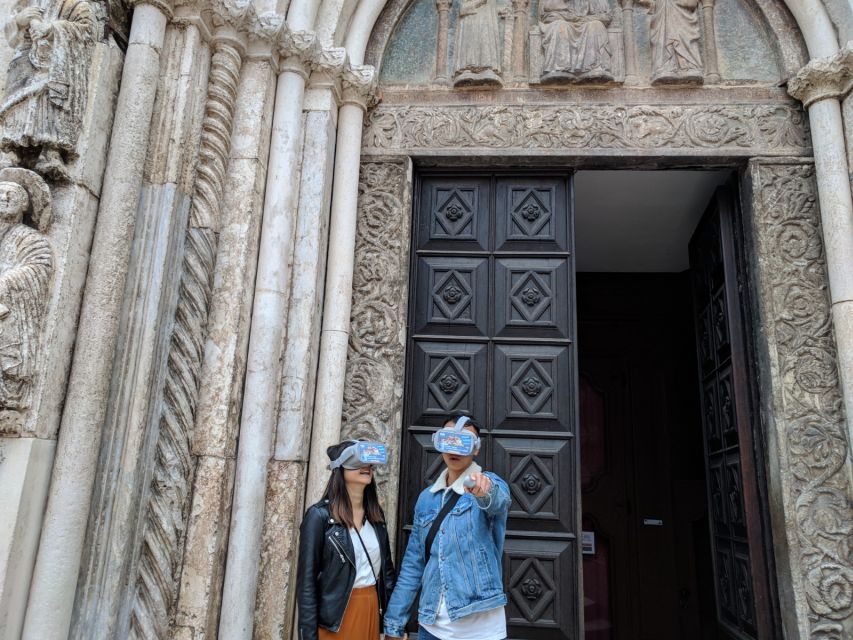
The clever idea here is simple: you walk to a real place in Zadar, then use the headset to see an earlier version of it. That connection matters. A picture in a museum can explain the past, but standing on the same stones while a 360-degree scene unfolds around you gives the history a physical anchor.
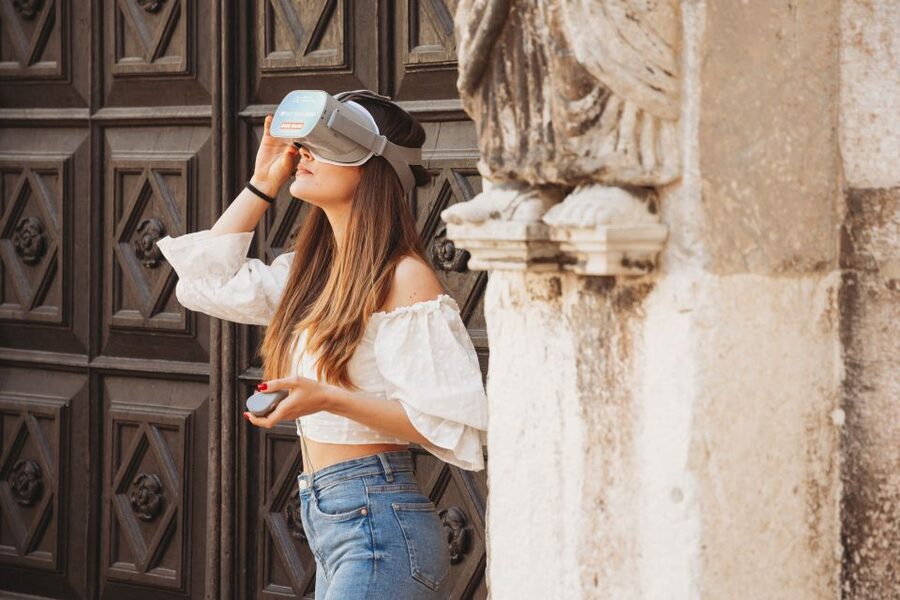
The equipment is an Oculus Go all-in-one VR headset with a controller. You do not need advanced technical skills. The interface lets you choose when to move to the next point, and the assistant remains nearby throughout the tour.
That last detail is important. Several parts of the experience involve pausing in a quiet or shaded spot while you look through the headset. German guest Peter specifically noted that the assistant chose calmer, shady places for these stops and answered questions along the way. In sunny Zadar, that is a practical touch, not just a courtesy.
The guide speaks English, while the audio guide is available in Croatian, English, Esperanto, French, German, Italian, and Spanish. You will still have a live assistant walking you through the city, so the language options mainly help you follow the historical narration at your own pace.
More Historical Tours in Zadar
- Zadar: Private Walking Tour Through 3,000 Years of History
★ 4.7 · 71 reviews - Zadar: Hinterland Hidden Treasures, Nature, History, Tasting
★ 5.0 · 11 reviews - Zadar: Private walking tour through history and modern time
★ 5.0 · 10 reviews
Meeting beside the Sea Gate
The tour begins at a souvenir shop in the red building next to Zadar’s Sea Gate, at Poljana Pape Aleksandra III 7. This is a useful starting point because the Sea Gate is close to the old town’s historic core, and you can reach the meeting place before the walk begins without searching through a large transport terminal or hotel complex.
Bring your passport or ID card. The activity lasts two hours, so allow enough time to arrive, find the red building, and get settled before the scheduled start.
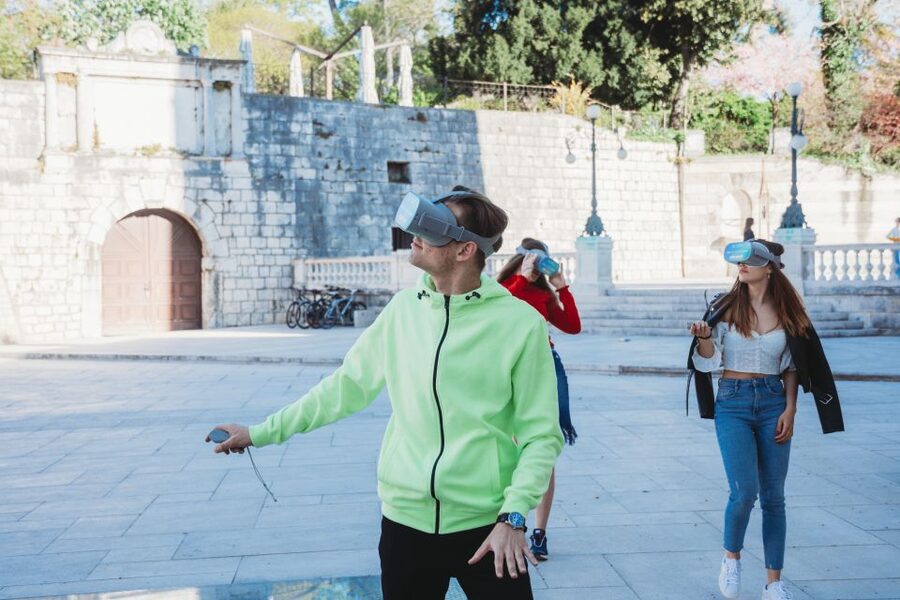
The walk itself is part of the value. You are not sitting in a dark room watching a historical film. You move through Zadar’s peninsula, hear the guide explain the setting, and then stop at selected points for the virtual scenes.
The tour is listed as wheelchair accessible. Since the experience takes place on an old-town walking route, you may still want to confirm any route concerns when booking, especially if you need very specific access details.
The Roman Forum as the center of ancient Zadar
The Roman Forum is one of the strongest stops because it connects the surviving stones under your feet with the city that once used this space as its social and economic center.
Today, you can see the remains and try to picture the original buildings. The VR version gives you more help. The 360-degree view, animated elements, 3D objects, and sound effects create a picture of how the forum functioned in Roman Zadar.
I like this kind of reconstruction because it explains scale and purpose. Ruins often leave you with fragments: a column, a wall, a paving stone. A virtual scene can show how those fragments fitted into a working public space.
The technology does not replace the real forum. It gives you a second layer of information. You can look at the actual site, then compare it with the virtual version. That makes the stop useful for first-time visitors who want a clear introduction to Zadar’s ancient past, as well as for families who need more than a traditional spoken explanation.
The visual quality is not cutting-edge. Amélie from Belgium found the images less polished than expected for 2025, and Aude from France also felt the graphics looked dated. You should approach the visuals as an educational reconstruction rather than a modern video game. The historical idea is the attraction, not photorealism.
Watching the 1202 invasion from the sea

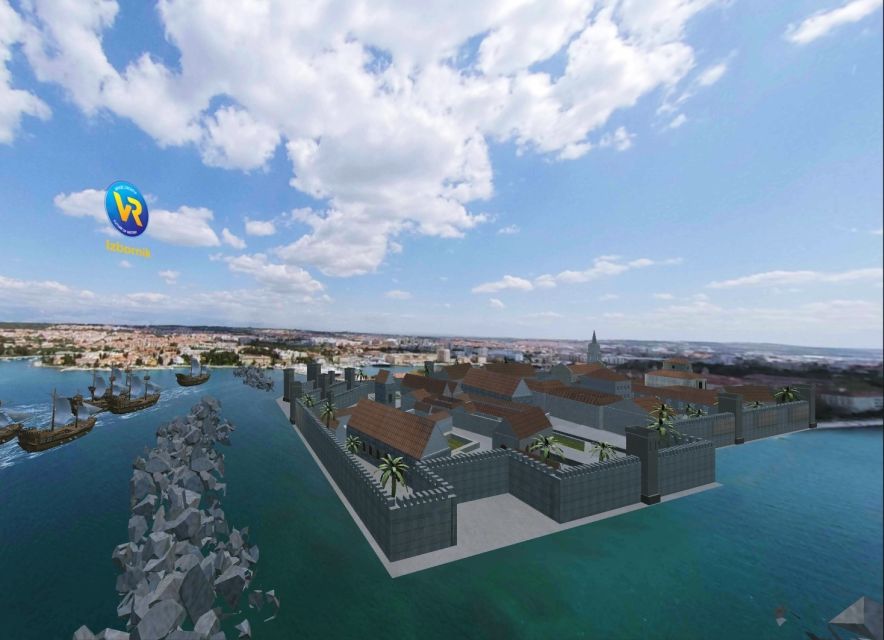
One of the more unusual scenes covers the Fourth Crusade and the invasion of Zadar in 1202. The VR program shows the attack approaching from the sea, placing you in an event that shaped the city’s medieval story.
This is where the format earns its keep. A spoken explanation can tell you that an attacking force arrived by water. A recreated view from the city helps you understand the direction and drama of the event. You can see the threat in relation to Zadar’s position on the peninsula, rather than treating the episode as a name and date.
The program also includes views of attacks from the air and sea during World War II. That gives the tour a broad time span, from Roman life through medieval conflict to the damage of the twentieth century.
Do not expect a full military history course. The tour is designed to offer compact information at several locations, not to examine every battle or political cause in detail. Peter described the information as brief but very good, which is a fair way to think about the format. You get enough context to understand what you are seeing, then move on before the experience becomes a long lecture.
More Walking Tours in Zadar
- Zadar: Guided Walking Tour
★ 4.8 · 445 reviews - Zadar City Tour 120min Walk
★ 5.0 · 203 reviews - Zadar: Evening Walking Tour of the Old Town
★ 4.8 · 25 reviews - Zadar: Old Town Highlights Guided Walking Tour
★ 4.3 · 23 reviews
Entering St. Chrysogonus’ Church virtually
St. Chrysogonus’ Church is a special stop because it is normally closed to the public. The VR headset gives you a way to look inside, even when a physical visit is not possible.
This is one of the tour’s best practical features. You are not simply viewing a famous place from the outside and hearing that it has an interior worth seeing. You get a virtual visit tied to the location in the city.
The experience can be especially useful if you are interested in religious buildings but have limited time or happen to visit when the church is closed. It also shows how VR can add access rather than merely recreate scenery.
The quality of the image matters here. A virtual interior will not give you the same feeling as walking through a real doorway, and the dated graphics may limit the fine detail you can appreciate. Still, the chance to see a normally inaccessible space makes this stop more than a standard church description.
Finding the old market on the modern map
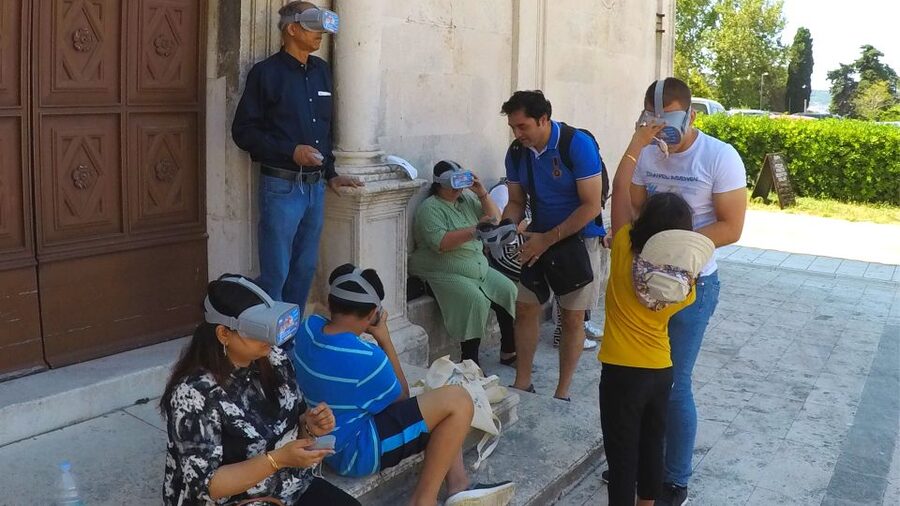
Another stop takes you to the location of the former city market. The important surprise is that the market was once on the other side of town compared with its present-day position.
This kind of detail helps you understand that historic cities are not frozen in place. Streets, public spaces, and daily routines shift over time. When you stand at the modern location and see the older arrangement, you begin to read Zadar as a changing city rather than a collection of preserved monuments.
The market scene also adds ordinary life to the program. Wars and Roman monuments draw attention, but a market shows where people bought goods, met neighbors, and handled daily business. That makes the historical story more human.
Rising above the peninsula in a hot-air balloon
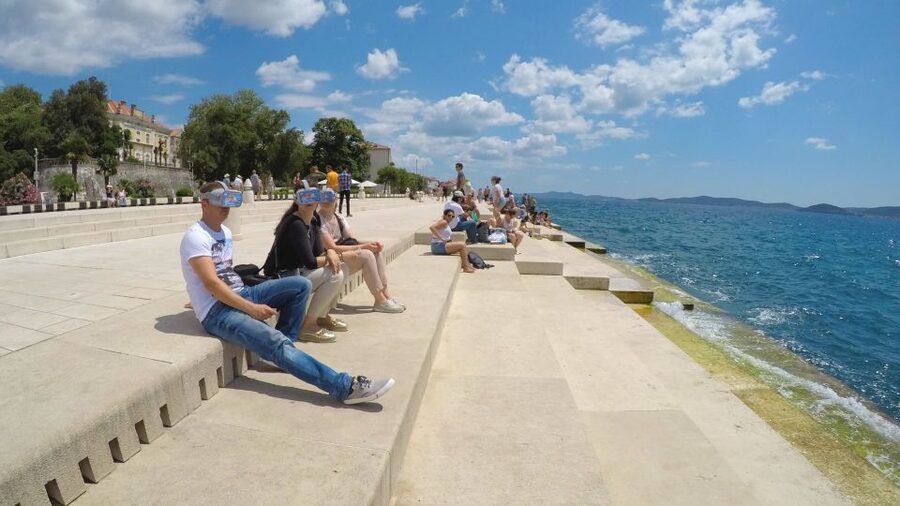
The hot-air-balloon scene gives you a broad view of the old city and its peninsula. You are not physically leaving the ground, but the virtual viewpoint helps you understand Zadar’s layout in a way that street level cannot.
I find aerial views useful at the start of any old-town visit because they turn a maze of lanes into a clear shape. Here, the scene also lets you compare the city’s form across different periods.
The balloon sequence is likely to be one of the most memorable moments for children, but it is not only for young visitors. If you are trying to understand how the sea, walls, gates, and urban spaces relate to one another, an elevated view can make the geography much easier to follow.
The program also shows how Zadar looked after World War II. That offers a visual bridge between wartime damage and the city you see today. Again, the value is in comparison: you can look at the present-day peninsula, then see a version shaped by destruction and rebuilding.
What the two-hour pace feels like
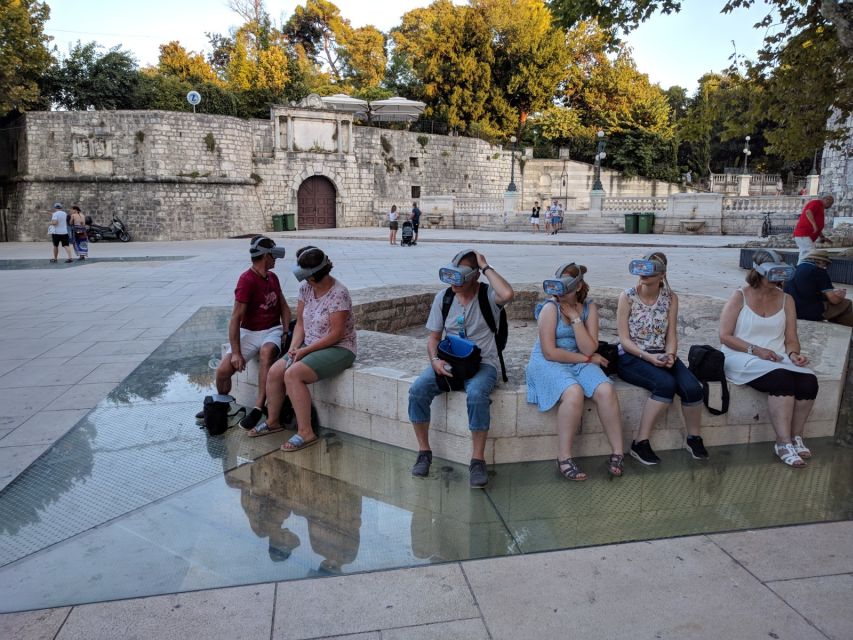
The tour combines walking time with several VR stops. The headset scenes are controlled by the user, so you can choose when to continue to the next point instead of being forced through a fixed video at one speed.
That simple control is a good design choice. Some people will want to look around every corner of a 360-degree view. Others will want to move on once the main point is clear. The guide can help you manage the controller and answer questions.
The pace also depends on the group and on the equipment. Valérie from France had trouble with some of the glasses and needed frequent help from the guide. That is worth keeping in mind if you prefer a completely hands-off experience. The assistant’s patience can make the difference between a smooth stop and a frustrating one.
Veronica is one guide named in the feedback, and she was described as friendly, clear, and good at sharing local information without overloading the group. Lindsay from the United Kingdom especially praised her local knowledge and found that the VR added excitement to the sightseeing.
You should expect a guided walk with technology support, not a private museum exhibit. The assistant has to manage people, equipment, questions, and the route. That personal help is one of the reasons the experience works, but it also means the quality of your session may depend partly on how smoothly the headset functions.
Is $35 a fair price for this Zadar tour?
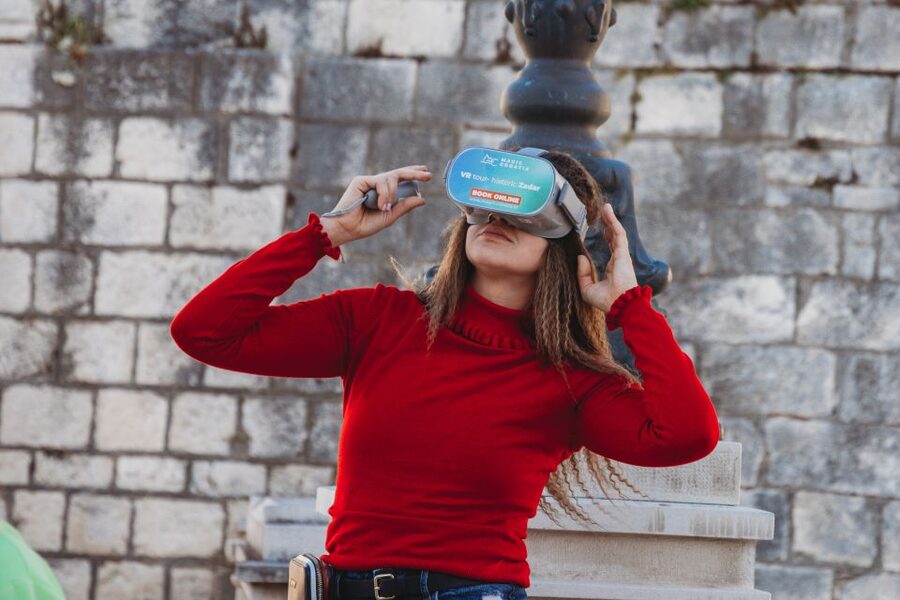
At $35 per person, the tour is priced above a basic free walk but includes more than a standard audio guide. The fee covers the Oculus Go headset and controller, the walking tour, and the tour assistant.
The value is strongest if you want several things at once: an introduction to Zadar’s main historic areas, visual reconstructions of lost scenes, and access to a normally closed church. The aerial view, Roman Forum reconstruction, medieval invasion, and WWII scenes cover a wide span of the city’s past in two hours.
The value is weaker if you already know Zadar well, dislike wearing headsets, or expect modern, high-resolution graphics. The images can look old-fashioned, and equipment may sometimes need hands-on help. You are paying for the concept, the historical content, and the guide’s support more than for premium visual effects.
Food and drinks are not included. That is easy to manage because the tour is only two hours, but plan a café stop separately if you want one before or after the walk.
Free cancellation is available up to 24 hours before the start, and you can reserve now and pay later. Those terms are helpful if your Dalmatian schedule may change, but the main decision should still be whether the VR format suits you.
Who will enjoy this experience most?

I would recommend the tour to first-time visitors who want a quick way to understand Zadar’s old town. The city has layers from Roman, medieval, wartime, and modern periods, and the headset gives you a visual link between them.
It is also a good fit for families. The technology adds a game-like element, and the balloon view, animated scenes, and attacks from sea and air can hold attention better than a long talk beside ruins. Still, the content covers war and destruction, so parents may want to judge the subject matter for younger children.
History fans will appreciate the range of time periods, especially the Roman Forum and the 1202 invasion. People interested in architecture may value the virtual look inside St. Chrysogonus’ Church.
You may want to skip it if you want a quiet, traditional walk with no equipment. You should also be realistic about image quality. The VR is interesting and useful, but it does not look like a brand-new film or a high-end gaming system.
My booking advice for Zadar’s VR history walk
Book this tour if you learn best through pictures, want a short introduction to Zadar, or are curious about places you cannot normally enter. The guide adds human explanation, while the headset gives you a view that ordinary sightseeing cannot provide.
I would not book it solely for cutting-edge technology. The graphics may seem dated, and some headsets can require repeated assistance. Go for the combination of real streets, local guidance, and historical scenes. At $35, that is a reasonable price when you treat the experience as a guided city walk with a visual history lesson attached.
FAQ
How long does the Zadar VR history tour last?
The tour lasts two hours and combines a walking tour with several virtual reality stops in Zadar’s old town.
How much does the tour cost?
The price is $35 per person.
Where is the meeting point?
Meet at the souvenir shop in the red building next to the Sea Gate, at Poljana Pape Aleksandra III 7, 23000 Zadar, Croatia.
What equipment is included?
The tour includes Oculus Go all-in-one VR glasses and a controller, along with a tour assistant and the walking tour.
Which languages are available?
The live instructor speaks English. The audio guide is available in Croatian, English, Esperanto, French, German, Italian, and Spanish.
Do I need technical experience to use the VR glasses?
No. The interface is designed to be simple, and the assistant is available throughout the tour to help you use the glasses and controller.
Is the tour wheelchair accessible?
Yes, the activity is listed as wheelchair accessible.
Can I cancel the booking?
Yes. You can cancel up to 24 hours in advance for a full refund. You can also reserve now and pay later.
Just added around Zadar
- Half-Day River Rafting in Zrmanja★ 5.0 · 7 reviews
- Zrce Booze Cruise – Novalja Boat party★ 4.5 · 26 reviews
- Canoe safari adventures at Zrmanja river day tour★ 5.0 · 11 reviews
- Canoe safari / rafting on river Zrmanja★ 5.0 · 81 reviews
- Zadar Archipelago 3 Islands Sea Kayaking Day Trip★ 5.0 · 9 reviews
- Zadar: Sunset Fishing Half-Day Guided Boat Trip★ 5.0 · 14 reviews
- Zadar: Sunset boat tour with champagne★ 5.0 · 6 reviews
- Romantic Sunset Cruise from Zadar by Speedboat★ 4.9 · 60 reviews
Historical Tours, compared.


Walking Tour of Split with a ‘Magister’ of History
Read our review →


Split History and Gastro Small-Group Tour with Food and Drinks
Read our review →
SPLIT-PREMIUM Emperor’s Walking Tour for History Lovers + Museum
Read our review →Browse the lists this tour appears in