
Reviewed · HISTORICAL TOURS
Split: Private Walking Tour in the Historical Town Center
Split’s old town is not a museum behind ropes. It is a living neighborhood built inside a Roman emperor’s palace, with cafés, homes, shops, churches, and laundry tucked among ancient walls. This private walk with Sanja takes you from the Riva into that remarkable mix of Roman, medieval, Venetian, French, Austro-Hungarian, and Yugoslav traces.
I like the private format, which makes it easier to ask questions and hear the guide in narrow streets. I also like the useful timing: 105 minutes gives you a clear first look without consuming half your day. The main consideration is price. At $153 for a group of up to 15, it is strong value for a larger party, but it can feel expensive for one or two people. The Substructures also require a separate entrance ticket.
Key Points
- Roman palace turned town center: Walk through Diocletian’s fourth-century palace and the medieval neighborhood that grew inside it.
- Sanja’s language range: The tour is offered in English, Italian, French, and Spanish.
- Private attention: Your group can ask questions and shape the conversation more easily than on a large shared walk.
- Several eras in one route: Roman, medieval, Venetian, French, Austro-Hungarian, and Yugoslav rule all appear in the streets and squares.
- A useful first-day orientation: The route gives you a map of Split’s key sights and ideas for further exploring.
- Separate Substructures fee: The underground level is included in the route, but admission is not included in the tour price.
Start on the Riva by the Bronze City Model
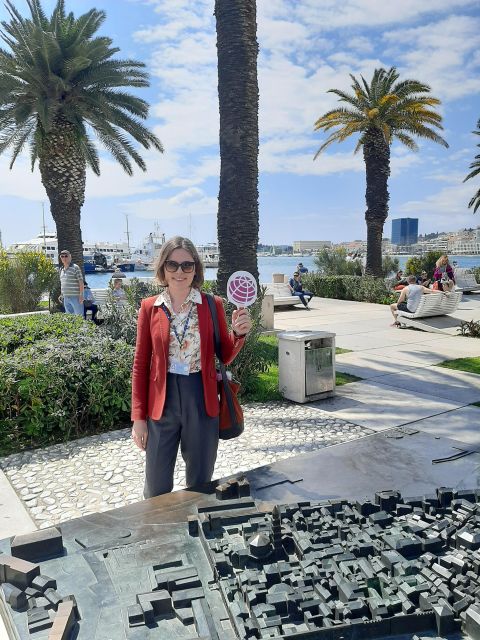
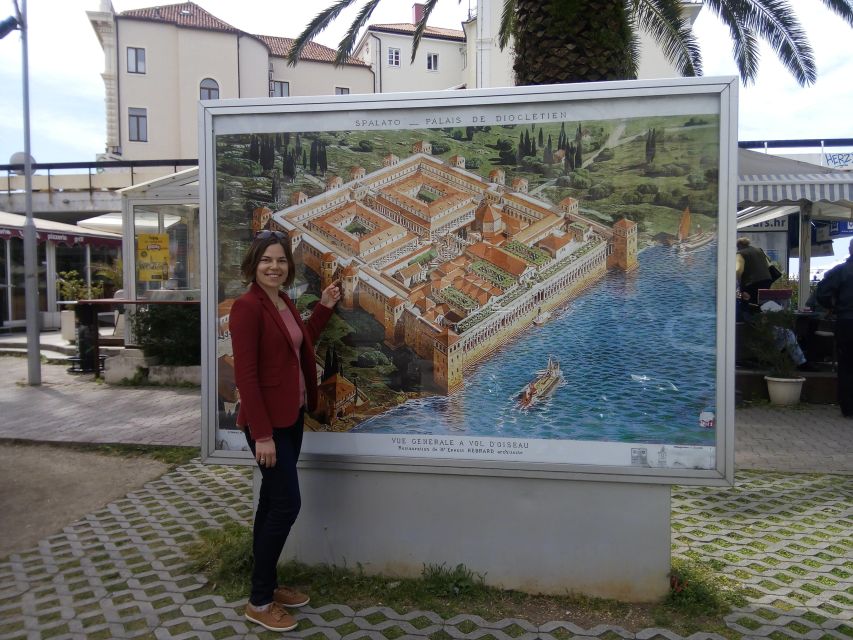
You meet beside the bronze model of Split’s historical core on the Riva promenade, directly in front of the south entrance to Diocletian’s Palace. This is a sensible place to begin. You can see the palace shape before entering it, and the location is easy to find beside the sea.
The Riva gives you an immediate clue about Split’s character. The waterfront is open and modern, while the palace entrance leads into a dense maze of old stone streets. That shift happens within a few steps, and Sanja uses it to explain how the Roman structure became the town you see today.
The meeting point matters because the palace has several entrances and many small lanes. Arriving at the bronze model helps you avoid beginning the tour lost in the center. I would arrive a little early, especially if you are meeting in summer, when the waterfront can be crowded.
More Historical Tours in Split
- Walking Tour of Split with a ‘Magister’ of History
★ 5.0 · 1,122 reviews - Split Walking Tour with Professor of History
★ 5.0 · 926 reviews - Split: History and Heritage Walking Tour
★ 4.9 · 650 reviews
Inside Diocletian’s Palace, Where the Town Grew Around Rome
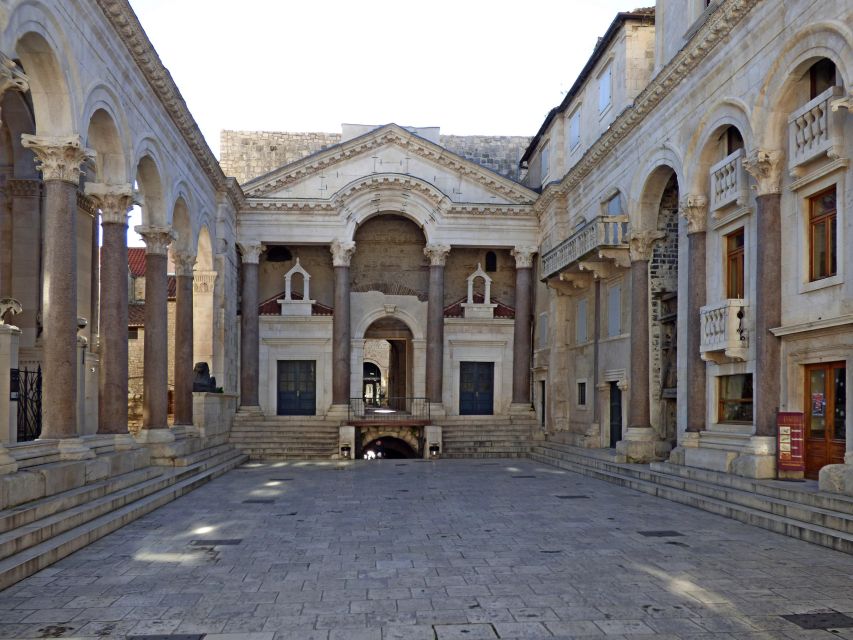
The first major section lasts about 30 minutes and focuses on Diocletian’s Palace, the oldest part of Split. Built in the fourth century for the Roman emperor Diocletian, the complex was both an imperial residence and a fortified structure.
Do not expect a quiet archaeological site. The palace is now part of the city. Medieval houses were built into and around the Roman remains, and ordinary urban life continues among the old stones. That mixture is the point. You are not only looking at ruins; you are learning how a Roman palace became the framework for a working town.
Sanja’s explanation is especially useful here because the architecture can seem confusing at first. A wall may be Roman, a doorway medieval, and an upper floor much later. The tour helps you read those layers instead of seeing one undifferentiated old quarter.
You will also see the palace walls and its four gates. Each gate helps explain how the complex was organized and how people moved through it. The Golden Gate is part of the route, while the southern entrance near the Riva provides the starting reference.
The Substructures Reveal the Palace Plan
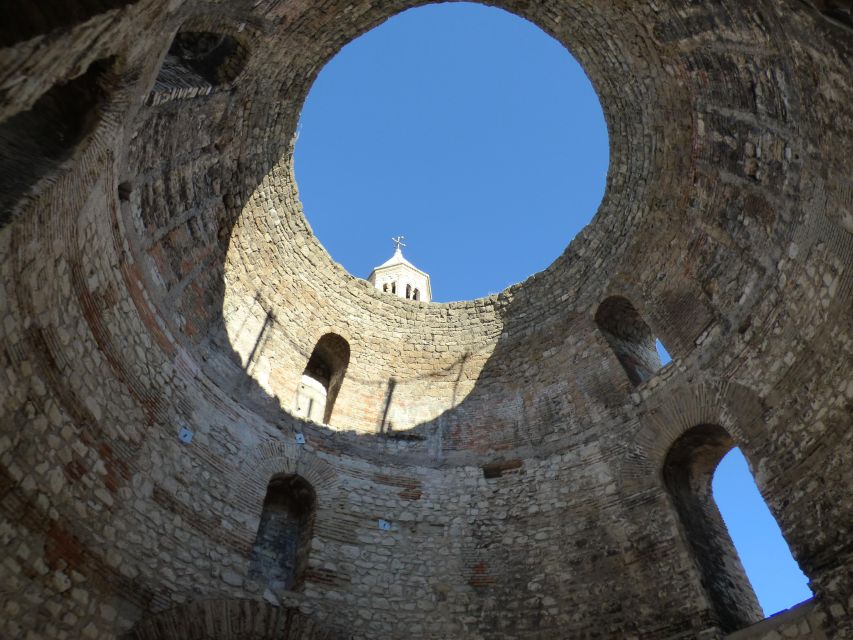
The Substructures, also called the Basements, are one of the most useful stops because they show the layout of the palace below ground. This part requires a separate entrance fee, so budget for that if you want the full experience.
The underground spaces help you understand the rooms above. Their preserved walls and passageways make the palace plan easier to picture, particularly when the upper level has been altered by later homes and streets. I would not treat this as an optional add-on if Roman architecture is your main reason for booking.
The practical drawback is simple: the entrance charge is not included. The tour price covers Sanja’s guiding, but you pay separately for access to the Substructures. Ask about the current admission cost when planning your day, since the supplied information does not state a fixed amount.
Peristil Shows the Palace at Its Grandest
Peristil is the palace’s principal ceremonial square, and the 10-minute stop gives Sanja a chance to explain how imperial power was presented. Its scale and stone surroundings make it one of the clearest places to grasp the palace’s original purpose.
This is also one of the busiest points in the old town, so a private guide is handy. Sanja can point out details while keeping your group together, and you can ask questions without waiting for a large crowd to move along.
I would pay attention to the contrast between the formal square and the everyday town around it. Split’s old center works best when you notice both sides at once: imperial ceremony in the stone plan, and normal city life in the lanes and buildings that came later.
More Walking Tours in Split
- Split: Old Town and Diocletian Palace Walking Tour
★ 4.9 · 4,727 reviews - Walking Tour of Split and Diocletian’s Palace
★ 5.0 · 2,588 reviews - Split & Diocletian’s Palace Walking Tour
★ 5.0 · 1,125 reviews - Split: Diocletian Palace & Old Town Guided Walking Tour
★ 4.7 · 882 reviews
Cathedral and Jupiter’s Temple, Roman Religion Meets Christian Split
The Cathedral of Saint Domnius occupies the former mausoleum of Diocletian. The route includes a guided look at the cathedral and a pass by, with about 10 minutes devoted to the stop.
That change of use is one of the tour’s most interesting themes. A building created for an emperor’s burial became a Christian cathedral. You are seeing religious and political change expressed through the same structure, not in separate museum displays.
Jupiter’s Temple, now the Baptistery, is another short stop. The tour covers it externally, with no entrance fee included or required for the described visit. Its presence helps explain the palace’s original Roman religious setting, while its later Christian use shows how the town adapted old buildings to new purposes.
The time at both sights is fairly brief. If you want a detailed interior visit to the cathedral or other religious buildings, you may need to return on your own. This walk is designed to give you context and orientation rather than replace every separate admission.
Medieval Lanes and the Former Jewish Quarter
Inside and around the palace, you will see medieval houses linked to noble families. Their presence makes clear that Split was not frozen after the Roman period. The old imperial compound became valuable city space, and later residents altered it for new needs.
The route also reaches a small former Jewish ghetto and a synagogue that remains active. This is an important detail because it adds a social dimension to the tour. You are not only following rulers and monuments. You are also learning how different communities lived within the old town.
The active synagogue is a place to approach with care and respect. The tour provides the historical setting, but it is not described as an interior visit. You should follow Sanja’s instructions and avoid treating a functioning religious site like a photo stop.
Pjaca and Fruit Square Trace Later Split
The second half leaves the palace area and moves through the medieval neighborhood outside it. At People’s Square, known as Pjaca, you begin to see how Split expanded beyond the original Roman compound.
Fruit Square offers another change in scale and character. These squares are useful stops because they show how public life shifted from the palace’s imperial center into later civic spaces. Sanja connects the buildings and street plan to the political eras that followed.
You will hear about life under Venetian, French, Austro-Hungarian, and Yugoslav rule. That sequence gives you a practical way to understand Split’s architecture. Rather than presenting each period as an isolated chapter, the tour shows how control of the city affected its public spaces, buildings, and daily life.
This is where a private format earns its keep. The political story may raise questions about identity, government, or architecture, and you can pause to ask about the parts that interest you most. A group of four, for example, can stay close to the guide and hear clearly in tight streets.
Prokurative Adds a More Formal Urban Finish
The tour includes Prokurative, officially the Republic Square, before returning toward the waterfront. Its planned appearance differs from the irregular lanes around the palace, giving you one more useful comparison.
The route is not just a list of monuments. It moves from Roman imperial planning to medieval growth, then into later civic spaces shaped by foreign rule. That progression makes the 105 minutes feel purposeful. You finish with a clearer sense of how Split changed instead of simply collecting disconnected photographs.
The final stop is back on the Riva. This return is convenient if you want to continue along the waterfront, find lunch, or revisit a palace site while the layout is still fresh in your mind.
Why a Private Group Changes the Value
The price is $153 per group of up to 15 people. For a full group, that works out to about $10 per person before any Substructures admission, which is a fair price for a private licensed guide and a focused route through Split’s most important center.
For a small group, the calculation changes. Two people pay the full group price, so you should compare the cost with a shared walk if keeping expenses low is your main concern. The benefit here is control: you can ask more questions, hear the guide more easily, and receive advice suited to your own plans.
Sanja is a licensed local guide with a master’s degree, and the strongest praise centers on her clear explanations, language ability, and personal approach. French-speaking visitors in particular can book confidently, while English, Italian, and Spanish are also available.
The tour has a perfect 5.0 rating from 25 reviews, with repeated praise for Sanja’s excellent French, strong English, friendly manner, and ability to explain how different powers shaped Split. One useful detail came through clearly: taking the tour early in a stay helps you understand the palace and choose what to revisit later.
Timing, Walking, and Who Should Book
At 105 minutes, this is a compact introduction rather than an all-day sightseeing program. You cover the principal Roman and medieval sights, several squares, and the waterfront without giving up the rest of your day.
You should expect continuous walking through old streets and squares. The experience is not suitable for wheelchair users, so accessibility is an important consideration before booking. The route also includes the Substructures, where surfaces and movement may differ from the outdoor streets, though no detailed access information is provided.
I would choose this tour for:
- A first visit to Split, especially on your first full day
- Couples or families who prefer a private guide
- Groups that want to share the cost among several people
- French, English, Italian, or Spanish speakers
- Anyone who wants political and architectural context, not just names and dates
I would think twice if you already know Diocletian’s Palace well, want long interior visits, or need a wheelchair-accessible route. You may also prefer a shared tour if $153 feels high for a very small party.
Small Details That Make the Walk Work Better
Wear shoes suited to old stone streets, and keep the schedule flexible enough to let the tour finish at the Riva. The stated duration is 105 minutes, so avoid booking another timed activity immediately afterward.
Because the route includes well-known squares and narrow palace streets, your guide’s voice and position matter. The private format helps here, particularly for a group of four or fewer. It also lets you stop for clarification when the Roman, medieval, Venetian, French, Austro-Hungarian, and Yugoslav layers begin to blur together.
Book the language you will follow most comfortably. Sanja’s French has received especially strong praise, but the tour is also offered in English, Italian, and Spanish.
Cancellation is flexible: you can cancel up to 24 hours in advance for a full refund. You can also reserve now and pay later, which helps if your Split plans are still moving around.
Should You Book This Split Walking Tour?
Book it if you want a private, efficient introduction to Split and plan to explore more after the guide leaves. Sanja’s route gives you the Roman palace, Substructures, cathedral, Jupiter’s Temple, medieval lanes, main squares, and waterfront in a logical order. It also explains the political changes that shaped the town, a useful advantage over a tour that only points at monuments.
The best value comes with a larger group, since the $153 fee covers up to 15 people. For one or two people, consider the cost carefully and remember that the Substructures admission is extra.
I would book this near the start of your stay, particularly if you want to return to the palace, cathedral, or squares with a better sense of what you are seeing. Skip it if you need wheelchair access or prefer to explore entirely at your own pace. For most first-time visitors who value clear history, personal questions, and a well-planned introduction, it is a smart way to get oriented.
FAQ
Where does the tour meet?
You meet by the bronze model of Split’s historical core on the Riva promenade, beside the sea and in front of the south entrance to Diocletian’s Palace.
How long does the tour last?
The walking tour lasts 105 minutes, or about 1 hour and 45 minutes.
What languages are available?
The live guide is available in English, Italian, French, and Spanish.
Is the tour private?
Yes. It is a private group tour, with a maximum group size of 15 people.
Is admission to Diocletian’s Palace Substructures included?
No. The Substructures, also called the Basements, require a separate entrance fee.
Which major sights are covered?
The route includes Diocletian’s Palace, Peristil, Saint Domnius’s Cathedral, Jupiter’s Temple, the Golden Gate, People’s Square, Fruit Square, Prokurative, and the Riva. It also covers palace walls, medieval noble houses, and the former Jewish quarter.
Is the tour suitable for wheelchair users?
No. The activity is not suitable for wheelchair users.
Can I cancel or pay later?
You can cancel up to 24 hours in advance for a full refund. You can also reserve now and pay later.
Just added around Split
- Split Day Trip from Dubrovnik★ 4.0 · 59 reviews
- Dubrovnik to Split Private Transfer with Local Experienced Driver★ 5.0 · 52 reviews
- Private Transfer from Dubrovnik to Split★ 5.0 · 3 reviews
- Private Transfer from Dubrovnik to Split with 2 hours for sightseeing★ 5.0 · 50 reviews
- Private Transfer: Dubrovnik to Split★ 5.0 · 7 reviews
- Dubrovnik to Split Private Transfer with Mostar Town★ 5.0 · 38 reviews
- Private Tour: Split Day Trip from Dubrovnik★ 5.0 · 9 reviews
- Private Day Trip :Dubrovnik- Mostar- Split★ 5.0 · 3 reviews
Historical Tours, compared.
Walking Tour of Split with a ‘Magister’ of History
Read our review →


Split History and Gastro Small-Group Tour with Food and Drinks
Read our review →
SPLIT-PREMIUM Emperor’s Walking Tour for History Lovers + Museum
Read our review →Browse the lists this tour appears in