
Reviewed · WALKING TOURS
Split: Old Town Guided Evening Walking Tour
Split’s old town is not a museum behind glass. It is a living Roman palace, with homes, shops, cafés, and narrow lanes filling spaces built about 1,700 years ago. This 70-minute evening walk gives you a quick way to understand that unusual mix, with stops at Peristyle Square, the underground cellars, the Temple of St. Jupiter, and St. Duje Cathedral.
I like the cooler timing and the $20 price, which makes this a sensible introduction before exploring alone. I also like the chance to hear local details from a guide such as Duje, who has tailored a small-group walk with Jewish heritage information. The main drawback is practical: one person missed the tour because the map marked the meeting point incorrectly, so you should confirm the exact start before heading out.
Key points at a glance
- A Roman palace that became a city: Walk through Diocletian’s Palace as part of Split’s everyday old town, not as a separate archaeological park.
- Evening timing helps in summer: The walk avoids the strongest daytime heat and gives the historic center a more relaxed feel.
- Four major sights in 70 minutes: See Peristyle Square, the underground cellars, the Temple of St. Jupiter, and St. Duje Cathedral.
- A useful first orientation: The route introduces the streets, squares, and layout of central Split before you explore on your own.
- English-speaking guiding: The tour is offered in English, with Duje named as a guide who can add Jewish heritage details in a small group.
- Check the port meeting point: Meet at Trg Braće Radić, in front of the large red SPLIT sign, where the guide carries a My Special Tour sign.
Why an evening walk works so well in Split
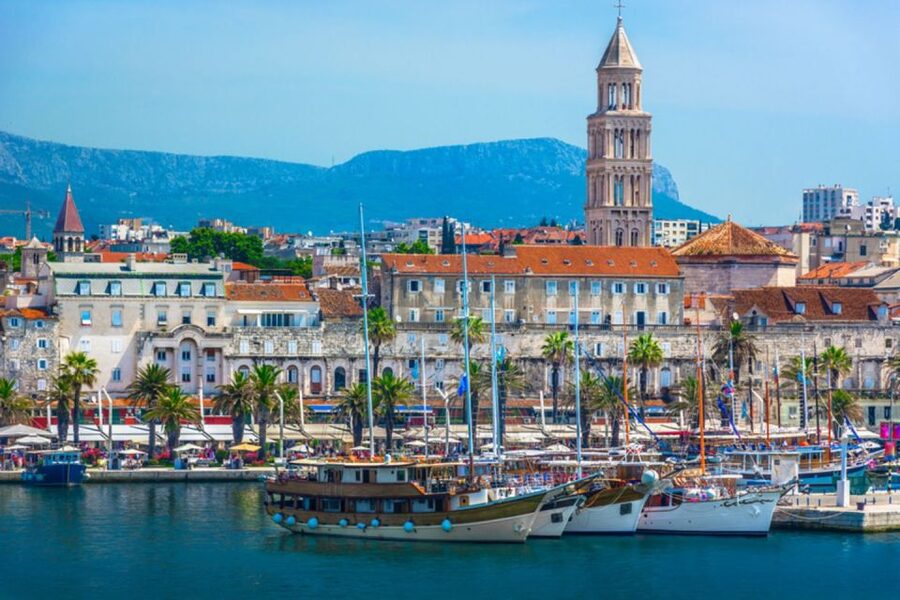
Split can feel hot and exposed during a summer afternoon, especially when you are walking across stone streets and open squares. Starting in the evening gives you a more comfortable way to see the old town without using your best sightseeing energy in the heat.
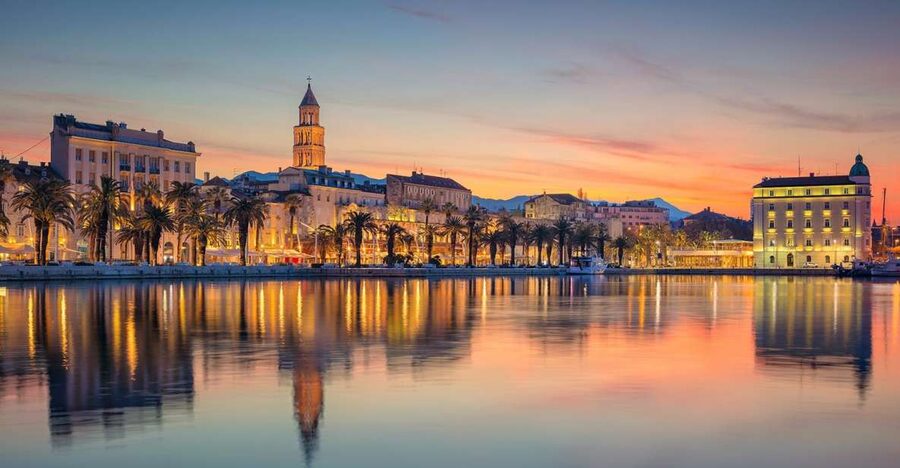
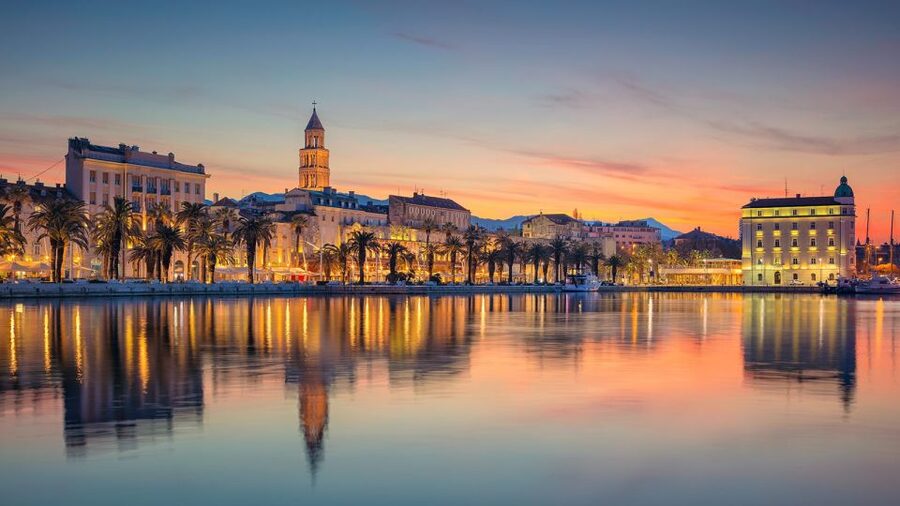
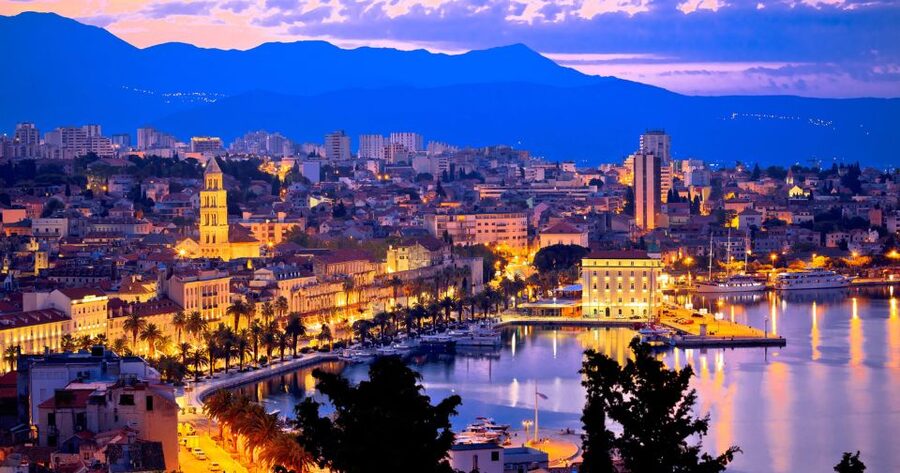
The timing also suits the character of the center. As daylight fades, the pale stone of the palace takes on a softer look, and the narrow streets become easier to appreciate. This is not a special night show or a theatrical performance. It is a guided walk at a cooler hour, which is exactly why it works for many people.
I would consider this tour an orientation rather than a full historical study. In 70 minutes, you can learn how the main parts of the old town connect, pick up the basic story of Emperor Diocletian, and mark places to revisit later. You will not have time for a long stop at every building.
That short length is useful if you arrive in Split by cruise ship, have a busy evening, or want a simple first look before dinner. It also means you should keep your expectations in check. The guide has to keep moving, and the amount of detail may depend on the group and the guide leading it.
More Walking Tours in Split
- Split: Old Town and Diocletian Palace Walking Tour
★ 4.9 · 4,727 reviews - Walking Tour of Split and Diocletian’s Palace
★ 5.0 · 2,588 reviews - Split & Diocletian’s Palace Walking Tour
★ 5.0 · 1,125 reviews
Entering a 1,700-year-old palace that still functions as a city
Diocletian’s Palace is the heart of this experience. The name can mislead you: you are not walking through an empty palace complex with every room preserved exactly as it was. The old palace has become part of Split, and people live and work inside its ancient walls.
That fact gives the walk its strongest sense of place. You can see how Roman foundations, medieval changes, later buildings, and modern life overlap in a compact area. The guide’s job is to help you read those layers instead of simply pointing at old stones.
The tour takes you through streets and squares in the special old section of Split. You will hear about the Roman period, the city’s cultural development, and the way the palace shaped Split’s layout. That basic context matters because the old town can otherwise feel like a maze of similar limestone lanes.
I like tours that explain how a place works, and this walk appears designed for that purpose. You get a map in your head: where the main square sits, how the palace spaces connect, and which major buildings deserve a closer look later.
Peristyle Square and the Roman center

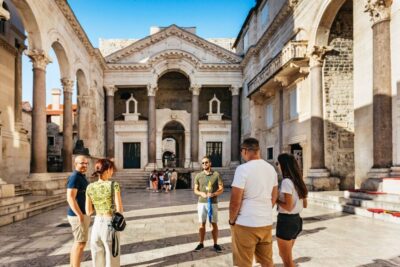
Peristyle Square is one of the key stops. It is the grand central space of Diocletian’s Palace, framed by monumental stone architecture and columns. This is the place where the scale of the original imperial complex becomes easiest to grasp.
Your guide can explain how the square related to the emperor’s palace and Roman ceremonies. The value here is not just the view. Peristyle gives you a reference point for the rest of the walk, helping you understand the difference between formal palace spaces and the tighter streets that grew around them.
The square can be an active public space, so do not expect a silent archaeological setting. People pass through, gather, and use the area as part of daily life. That is part of the appeal, but it can also make it harder to hear every word if the group is large or the area is busy.
Because the walk is short, you may spend only a limited time here. If Peristyle is your favorite stop, return during daylight and again after dark. The tour helps you understand what you are seeing, then you can come back with your own time and camera.
Underground cellars and the palace below street level
The underground cellars add a different side of Split’s past. They show how much of the palace survives below the modern town and help you picture the original structure from another angle.
For many people, this will be one of the clearest stops on the route. The upper streets have changed over centuries, but the cellars make the Roman plan easier to imagine. A guide can connect the lower rooms with the spaces above, giving you a better sense of how the palace was built and used.
Do not expect a long cellar visit with extensive free time. The tour lasts only 70 minutes and includes several major sights, so this part is likely a concise introduction. Still, it earns its place because it changes your view of the old town. Split is not only a collection of attractive lanes. It is a layered structure with substantial remains beneath your feet.
If you prefer historical sites that reveal construction and city planning, rather than only grand façades, this stop adds real value to the $20 fee.
Same stretch of coast, a completely different kind of day:
- Blue Lagoon & 3 Islands Cruise with Lunch from Split
★ 4.5 · 5,756 reviews - Split: Blue Lagoon Boat Party with DJs, Shots & After Party
★ 4.9 · 4,610 reviews - Split: Blue Lagoon and 3 Islands Speedboat Tour
★ 4.8 · 3,406 reviews - Blue Cave & 6 Islands Speedboat Tour From Split or Podstrana
★ 5.0 · 3,195 reviews
The Temple of St. Jupiter and changing religious spaces
The Temple of St. Jupiter shows the religious side of the Roman palace. It gives the guide a chance to explain beliefs and imperial symbolism from the ancient period, while also showing how old sacred spaces can take on new meaning as a city changes.
The stop is especially useful when placed beside the cathedral later in the walk. You begin with a Roman temple and then see how Split’s religious identity developed through later centuries. The route does not treat the palace as a single frozen moment. It presents a place that was altered, reused, and absorbed into the city.
The temple is not likely to take up a large part of a 70-minute walk. You will get an explanation and a look, then continue through the old town. That suits people who want a broad introduction, but anyone hoping for long architectural analysis should plan extra time alone.
St. Duje Cathedral and Split’s later story
St. Duje Cathedral, also called the Cathedral of St. Domnius, adds one of the old town’s most important later buildings to the route. Its presence inside the former palace helps show how Roman imperial space was adapted for a Christian city.
The cathedral is valuable as a contrast to the Temple of St. Jupiter. You can see how the same urban center carried different religious and political meanings over time. A guide can make that change understandable in a few clear steps, which is more useful than seeing the cathedral as an isolated photo stop.
The tour information does not promise entry into every interior or a special cathedral visit, so you should think of this as an exterior and historical stop unless your guide says otherwise. The walk focuses on the old town as a whole, not on extended access to one monument.
If you have time after the tour, St. Duje Cathedral is a sensible place to study more closely. The guided visit gives you the background needed to notice details you might otherwise pass without a second thought.
A closer look at the guide experience
The tour is conducted in English. Duje is specifically associated with a detailed walking tour, and a small group allowed him to add information about Split’s Jewish heritage. That detail matters because it suggests the walk can respond to the interests of the people present instead of following a rigid script every minute.
You should not assume Duje will lead every departure, however. The experience is offered with a guide, and Duje is the named guide in the available feedback, but the booking information does not guarantee his presence on a particular date.
The strongest reason to choose a guided walk is the explanation between the sights. You can walk through Peristyle or pass a Roman wall by yourself, but it takes a guide to connect the architecture with the city’s long development. The additional Jewish heritage material is a welcome sign that the tour can go beyond the most familiar Roman and Christian stories when time and group size allow.
The small-group point is important, but no fixed maximum group size is provided. If you want the most personal experience possible, ask about the expected group size before booking. A quieter group should make it easier to ask questions and hear the guide in crowded streets.
The $20 price and what you receive
At $20 per person, this is priced as an affordable introduction rather than a premium private tour. You receive the walking tour and an English-speaking guide. Hotel pickup, hotel drop-off, transport, food, and separate admission services are not included.
For me, the value depends on how you use the 70 minutes. If you are new to Split, the tour can save you time by explaining the layout quickly and identifying the places worth revisiting. The price is reasonable for that orientation, especially when the evening timing helps you avoid the hottest part of the day.
If you already know Diocletian’s Palace well, the value is less certain. The route is short, and it covers several sights rather than offering a long specialist discussion of one building. You may prefer exploring independently with a guidebook or audio guide if you mainly want quiet time for photographs.
The best value comes when you treat the walk as the first chapter of your Split visit. Listen for the city’s structure, note the locations of the cellars and cathedral, and return later to the places that interest you most.
Finding the meeting point at Split port
The stated meeting point is at Split port, on Trg Braće Radić. Look for the large red SPLIT sign, and the guide should carry a My Special Tour sign.
This detail deserves special attention because the map location has caused confusion. One person missed the walk after relying on an incorrectly marked starting point. I would not leave this until the last minute. Check the written meeting instructions, allow extra time to find Trg Braće Radić, and confirm the exact location with the provider if the map and text do not match.
The activity ends back at the meeting point, which makes planning easier. You can arrange dinner or continue exploring from the same central area without needing a separate ride back to a hotel.
There is no hotel pickup or drop-off. You need to reach the port meeting point yourself, so this tour is best for people already staying near central Split or able to get there independently.
Who should book this walking tour?
I would recommend it most strongly to first-time visitors who want a clear introduction to Split without committing to a long tour. It also fits cruise passengers, couples looking for a cooler evening activity, and anyone who prefers history explained in a compact format.
It is a good choice if you want to see the main old-town landmarks while avoiding summer heat. The route offers enough variety to keep a short walk interesting: an imperial square, underground rooms, a Roman temple, a cathedral, and the surrounding streets.
You might choose something else if you need guaranteed access inside every monument, a private guide, a longer route, or a highly specialized focus on Roman architecture. The tour is also not ideal if you are likely to arrive late, since the meeting point needs careful attention and the walk has a fixed duration.
For history fans, the possible Jewish heritage material with Duje is a pleasant extra, but it should be treated as a bonus rather than the central promise of the tour.
Should you book the Split evening walk?
Book it if you want a low-cost, low-commitment way to get oriented in Split after the heat of the day. The palace, Peristyle Square, cellars, Temple of St. Jupiter, and St. Duje Cathedral give you a solid range of sights in 70 minutes, while the evening schedule makes the walk easier on hot days.
I would book with one condition: verify the meeting point before setting out. The map confusion is the clearest practical risk. If you confirm the location and accept that this is a brief overview rather than an exhaustive tour, the experience offers a useful introduction at a fair price.
You can reserve now and pay later, and cancellation is allowed up to 24 hours before the tour for a full refund. That flexibility helps if your Split schedule is still shifting.
FAQ
How long does the Split evening walking tour last?
The guided walk lasts 70 minutes.
What language is the tour offered in?
The tour is offered in English.
Where does the tour start?
It starts at Split port, at Trg Braće Radić. Look for the large red SPLIT sign and a guide carrying a My Special Tour sign.
Where does the tour end?
The activity ends back at the meeting point.
Which sights are included?
The walk includes Diocletian’s Palace, Peristyle Square, the underground cellars, the Temple of St. Jupiter, St. Duje Cathedral, and other parts of Split’s old town.
Is hotel pickup included?
No. Hotel pickup and drop-off are not included.
How much does the tour cost?
The listed price is $20 per person. You can reserve and pay later, with no payment required at booking.
Can I cancel for a full refund?
Yes. You can cancel up to 24 hours in advance for a full refund.
More Evening Experiences in Split
- Split: Illuminated Evening Guided Kayaking Tour
★ 4.8 · 1,622 reviews - Split: Stand Up Paddleboard Night Glow Tour
★ 4.9 · 916 reviews - Split: Transparent SUP night Glow tour
★ 4.9 · 73 reviews - Split: Night Boat Party with Free Shots, Dj and After Party
★ 4.8 · 61 reviews
Just added around Split
- Split Day Trip from Dubrovnik★ 4.0 · 59 reviews
- Dubrovnik to Split Private Transfer with Local Experienced Driver★ 5.0 · 52 reviews
- Private Transfer from Dubrovnik to Split★ 5.0 · 3 reviews
- Private Transfer from Dubrovnik to Split with 2 hours for sightseeing★ 5.0 · 50 reviews
- Private Transfer: Dubrovnik to Split★ 5.0 · 7 reviews
- Dubrovnik to Split Private Transfer with Mostar Town★ 5.0 · 38 reviews
- Private Tour: Split Day Trip from Dubrovnik★ 5.0 · 9 reviews
- Private Day Trip :Dubrovnik- Mostar- Split★ 5.0 · 3 reviews
Walking Tours, compared.
Split: Old Town and Diocletian Palace Walking Tour
Read our review →
Walking Tour of Split and Diocletian’s Palace
Read our review →

Krka Waterfalls tour with Trogir Walking tour and Krka panoramic boat cruise
Read our review →
Dubrovnik: City Walls Early Morning or Sunset Walking Tour
Read our review →Browse the lists this tour appears in