
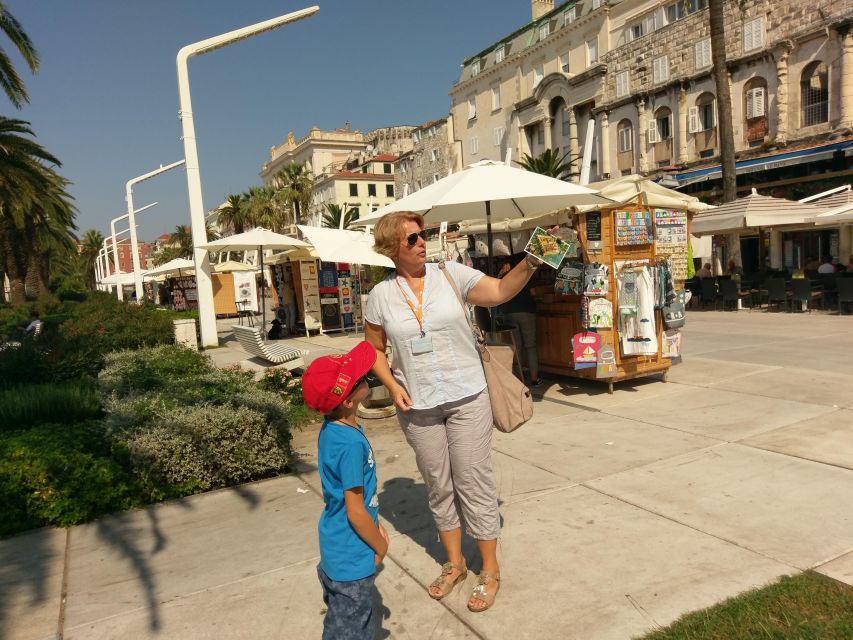
Reviewed · WALKING TOURS
Split: city center private walking tour 2 h
Split’s best sightseeing happens inside its old center, where Diocletian’s Palace is not a museum but the living heart of the city. Roman walls, medieval lanes, shops, cafés, homes, and market stalls all share the same tight space. This private two-hour walk gives you a useful framework for understanding it, from the palace cellars and Peristil to the waterfront Riva.
I like the private format, especially for families or small groups that want to ask questions and set a comfortable pace. I also like the range of sights: you get Roman monuments, Venetian-era squares, local markets, and Split’s daily street life in one compact walk. The main consideration is that two hours is tight, and one past booking found the walk less extensive than expected. If you want long wandering through side streets, ask the guide to make that a priority.
Key points at a glance
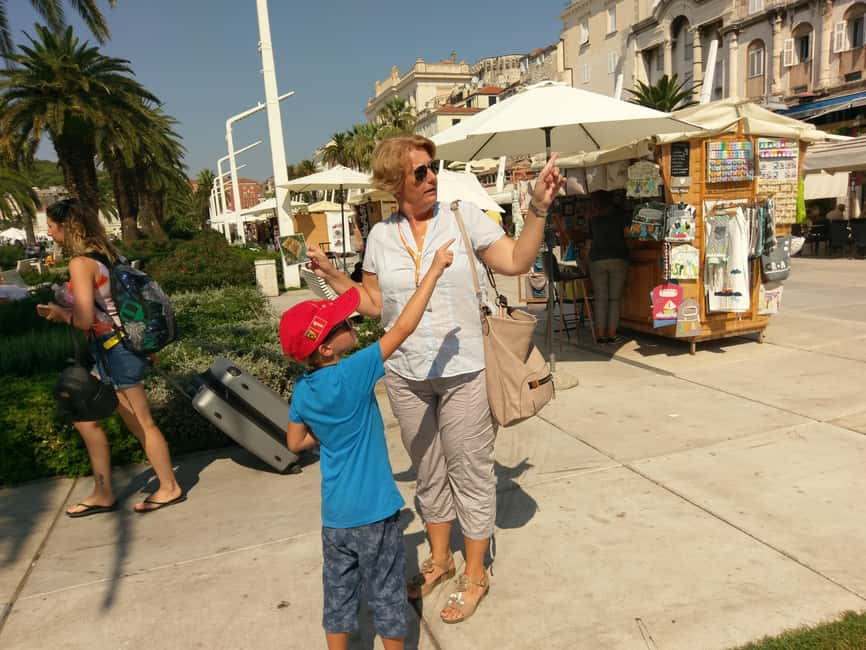
- Roman palace beneath a modern city: Explore Diocletian’s cellars and the imperial ceremonial center at Peristil.
- A true private tour: One group of up to 20 can request a pace and focus suited to its interests.
- Split beyond the palace: The route includes Riva, the Green Market, Fishmarket, medieval squares, and the Golden Gate.
- Guides with strong language skills: Tours are offered in English, French, and Croatian. Guides named in guest feedback include Zrinka, Zinka, and Yvonna.
- Useful first-day orientation: Finish with practical local advice and a clear sense of how Split’s center fits together.
- Budget for admission fees: Cathedral and palace cellar entry are not included in the $141 group price.
Start on Riva, where Roman Split meets modern Split
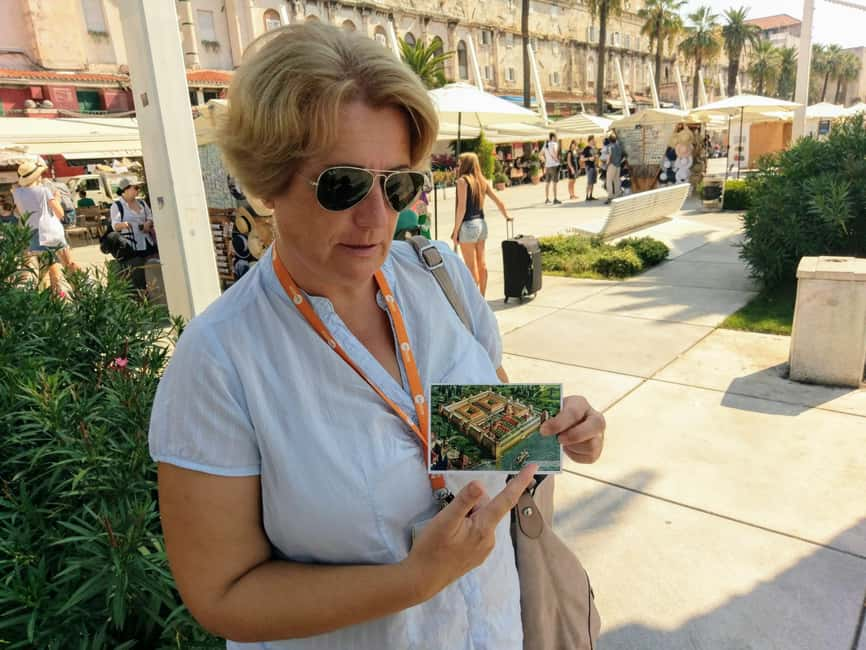
You meet on the Riva promenade, in front of the entrance to the cellars of Diocletian’s Palace at Obala Hrvatskog narodnog preporoda 15b. This is a sensible starting point. The waterfront is easy to identify, and the nearby model of Split’s historical core helps you see the city’s unusual shape before you begin walking.
Riva is more than a pretty promenade. It is Split’s public front room, lined with cafés and restaurants and used as a gathering place, especially in summer. From here, your guide can explain how the palace became the center of today’s city instead of remaining an isolated archaeological site.
The Green Market comes next, with about 10 minutes set aside for a visit and shopping. This is a good stop for seeing the everyday side of Split. It gives the tour a local rhythm before the grand Roman sights take over. You may want to ask your guide about produce, shopping habits, or what is worth buying for a picnic.
The Fishmarket is also included later in the walk. Together, the two markets help balance the palace monuments with ordinary city life. The stops are short, so think of them as quick orientation points rather than a full food tour.
More Walking Tours in Split
- Split: Old Town and Diocletian Palace Walking Tour
★ 4.9 · 4,727 reviews - Walking Tour of Split and Diocletian’s Palace
★ 5.0 · 2,588 reviews - Split & Diocletian’s Palace Walking Tour
★ 5.0 · 1,125 reviews
Enter the cellars beneath Diocletian’s Palace
The palace cellars are one of the tour’s main attractions. Their original architectural job was to support and raise the imperial residential area above them. Today, they offer a clear look at the Roman plan and give you a sense of how much of Split was built within and around the emperor’s complex.
The cellars have also appeared as a filming location for Game of Thrones. That detail may appeal to fans, but the more useful reason to visit is structural: the lower rooms help explain the upper palace. Without them, it can be hard to understand where the Roman palace ends and the later city begins.
Entry to the cellars costs extra, so check the current admission arrangements when booking. The tour includes a licensed guide, not the entrance fees. This matters when comparing the $141 price with other walking tours. For a full private group of 10 or 20, the cost can be good value. For one or two people, the same fixed group rate feels much higher than a shared walk.
The meeting point is directly by the cellar entrance, but you should still arrive with enough time to find the guide. Split’s center can be crowded, and the old streets are not laid out like a modern grid.
Peristil reveals the palace’s public face
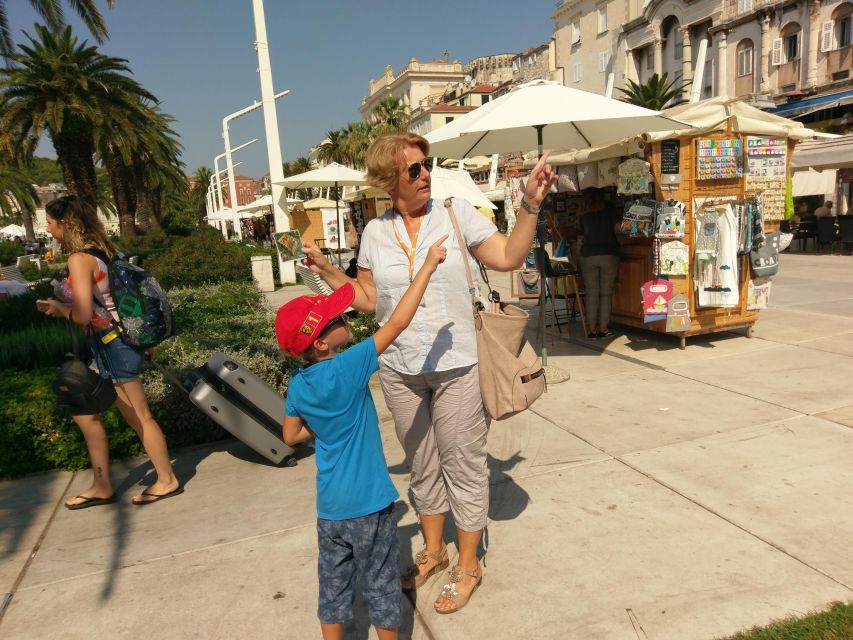
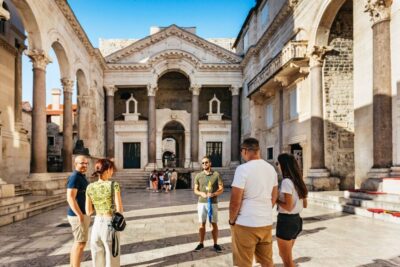
After the lower rooms, you walk up to Peristil, the ceremonial square at the center of Diocletian’s Palace. This is where the palace’s political and religious purpose becomes easier to read. The emperor used the space in connection with the cult of the living son of Jupiter, and your guide can point out the surviving elements around the square.
Peristil is a compact stop, listed at about 15 minutes, but it deserves close attention. Look up and around rather than treating it as a quick photo stop. The surrounding stone, columns, steps, and later buildings show how Roman design was reused over many centuries.
The nearby Temple of Jupiter adds another layer. It was connected to the imperial cult, while later Christian use changed the meaning of parts of the palace. Split is at its most interesting here, where one public space carries several different periods at once.
This is also a place where a private guide helps. You can ask for the basic story, or spend longer on architecture, religion, or the filming connection. The advertised two-hour length means the guide will need to keep an eye on time.
St. Duje and the palace’s Christian afterlife
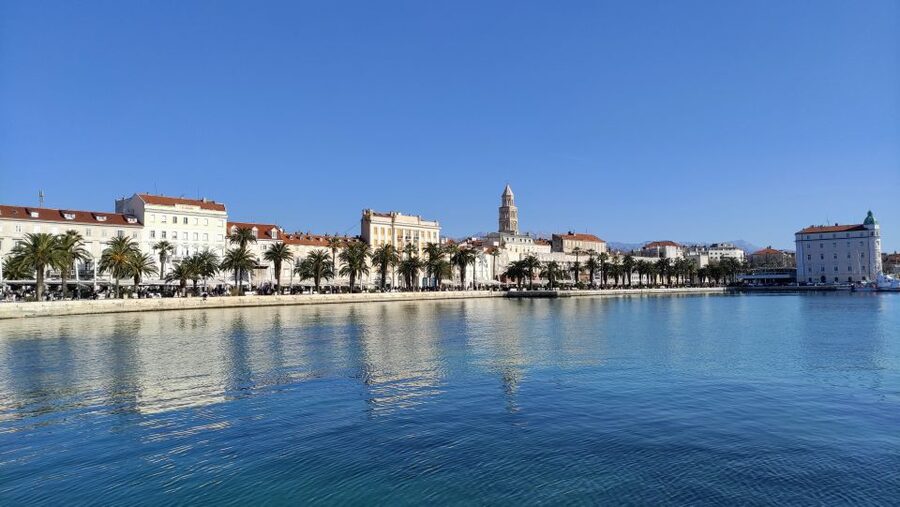
The Cathedral of St. Duje is especially unusual because the building began as Diocletian’s mausoleum. It is dedicated to Split’s patron saint, St. Duje, and is often described as the oldest cathedral in the world.
That claim needs a little care, since definitions of oldest can vary, but the building’s Roman-to-Christian transformation is clear and important. You are not simply seeing a cathedral beside an ancient palace. You are seeing a later religious institution occupying the former tomb of the emperor who ordered the palace built.
Cathedral entry is not included. If you want to go inside, shoulders and knees must be covered. Wear suitable clothing even in hot weather, or bring a light layer so you are not caught unprepared.
The cathedral is listed as part of the palace sightseeing, but the paid interior visit may affect how much time remains for the streets and squares. Tell the guide early if the cathedral matters to you more than market stops or shopping.
Same stretch of coast, a completely different kind of day:
- Blue Lagoon & 3 Islands Cruise with Lunch from Split
★ 4.5 · 5,756 reviews - Split: Blue Lagoon Boat Party with DJs, Shots & After Party
★ 4.9 · 4,610 reviews - Split: Blue Lagoon and 3 Islands Speedboat Tour
★ 4.8 · 3,406 reviews - Blue Cave & 6 Islands Speedboat Tour From Split or Podstrana
★ 5.0 · 3,195 reviews
From the Golden Gate to the medieval city
The Golden Gate is one of Split’s most recognizable Roman entrances. The stop is mainly for photographs and explanation, with roughly 10 minutes allowed. It helps you understand how people once entered the palace and how the old defensive design shaped movement through the center.
Nearby is the statue of Gregory of Nin, which gets another short photo stop. The monument is easy to recognize, and the guide can place it within Split’s public spaces and local identity. This is a quick stop, but it breaks up the Roman architecture with a piece of the city’s later story.
The route then moves into the medieval section around People’s Square, or Pjaca. This area dates from the period of Venetian rule and feels different from the palace interior. You see how Split expanded beyond the imperial compound while keeping the old Roman core as its anchor.
People’s Square allows about 15 minutes for a visit, photographs, and shopping. The Old Town Hall receives a shorter photo stop. These places are useful for understanding Split as a working city, not just an archaeological attraction.
Fruit Square and the short streets of old Split
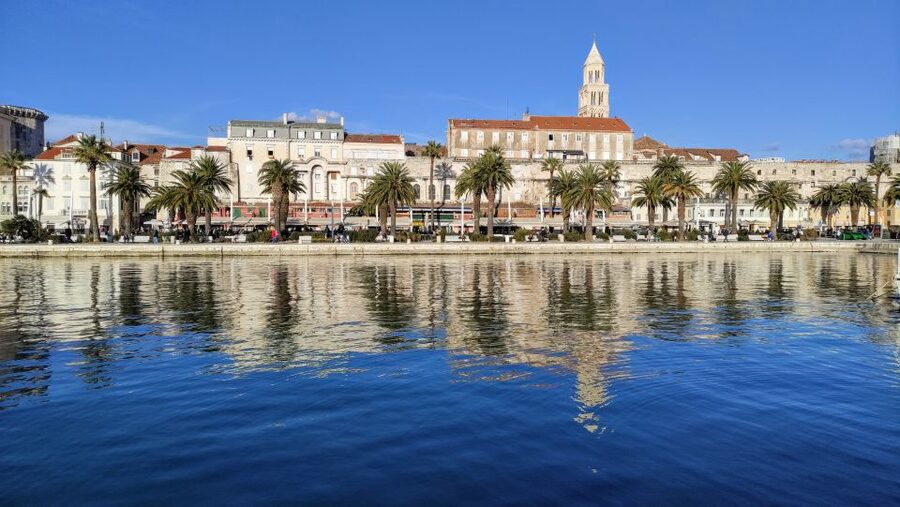
Fruit Square, or Voćni trg, is another compact but attractive urban space. Its name comes from the fruit sellers who once used the square, and it remains one of the places where the old center opens up after the narrow lanes around the palace.
The stop is listed at about 15 minutes. Use it to look at the surrounding façades and to ask how the Venetian period shaped this side of town. The tour is not designed as a long architectural walk through every alley, so speak up if you want more time in the small streets.
That point is important. One booking gave the guide high marks for explanations but found there was not as much walking as expected on a walking tour. The route covers many named sights, yet several stops are brief and close together. You will gain a strong overview, but you should not expect two hours of continuous wandering through every lane in the old center.
What the two-hour format really gives you
The route includes 12 points, with stops ranging from about 5 to 45 minutes. The palace receives the longest listed section, around 45 minutes, while the other locations are mostly short visits or photo stops. The individual time estimates add up to more than two hours, so treat them as rough planning notes rather than a promise that every stop receives the full stated time.
In practice, this is best seen as a guided introduction. You get the broad shape of Split, the major palace landmarks, the principal squares, and both markets. You also get a chance to ask the guide to adjust the emphasis.
That private control is the strongest reason to choose this experience. You can request more Roman history, more medieval Split, more local markets, or more practical advice for the rest of your stay. Guides named in past bookings include Zrinka and Zinka, who were praised for humor, local advice, and clear French, as well as Yvonna, whose enthusiasm for Split came through strongly.
The guide languages are English, French, and Croatian. If you need French, this is a useful choice, since several French-speaking bookings specifically praised the guide’s fluency and explanations.
Price, group size, and what is included
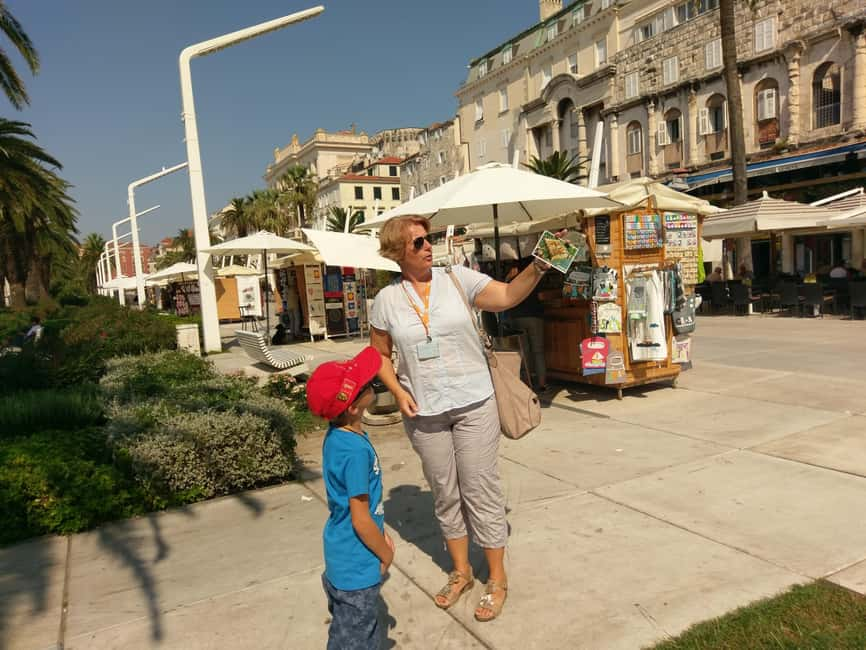
The price is $141 per private group of up to 20 people. That is not a low price for one or two people, but it can be sensible for a larger family, reunion, or small organized group. At 10 people, it works out to about $14 per person; at 20, about $7 per person, before admission fees.
The value comes from the private guide and the ability to shape the pace. A shared group tour may cost less for couples, while this option makes more sense when you want personal attention or have mixed interests within the group.
Only a licensed guide is included. Transfers are not included, and you make your own way to the Riva meeting point. Cellar and cathedral tickets are also extra, so add those costs before comparing the total price.
The tour is marked wheelchair accessible, but the old center includes uneven surfaces and many historic steps. The practical advice is to wear comfortable shoes and ask ahead about the exact parts you plan to enter. Even able walkers should take the footwear warning seriously.
Cancellation details appear in two forms: free cancellation is stated up to 24 hours before the tour, while another note says cancellation is free up to 14 days before the tour and no refund is available after that point. Because those terms conflict, confirm the policy shown at checkout before paying.
Who should book this private Split walk?
I would choose this tour for a first visit, especially if you want the palace explained rather than simply photographed. It is also a good fit for families, older relatives who need a slower pace, and French-speaking groups looking for a guide who can explain the city clearly.
It works well at the start of a stay because the route connects the waterfront, palace, markets, squares, and main gates. Afterward, you will know where Riva, Pjaca, Fruit Square, the markets, and the palace entrance fit together.
I would think twice if your main goal is a long walk through little-used lanes or a full interior visit to every monument. The tour is compact, and the listed stops leave limited time for unplanned detours. Ask for an alley-focused route at the start, or choose a longer walking experience if extensive exploration matters most.
Should you book it?
Book this tour if you want a private, well-organized introduction to Split’s Roman and medieval center, with a guide who can work in English, French, or Croatian. The palace cellars, Peristil, cathedral exterior, Golden Gate, markets, and squares make a sensible first look at the city.
The $141 price is strongest for a larger group. For two people, it is harder to justify unless personal pacing, language, and direct questions matter more than saving money. Also confirm the cancellation terms and budget for the cathedral and cellar admissions.
FAQ
Where does the tour meet?
The meeting point is on Riva, in front of the entrance to the cellars of Diocletian’s Palace at Obala Hrvatskog narodnog preporoda 15b, 21000 Split, Croatia.
How long is the tour?
The tour lasts two hours.
Is this a private tour?
Yes. It is a private group experience for up to 20 people.
Which languages are available?
The live guide can conduct the tour in English, French, or Croatian.
Are entrance fees included?
No. Entrance fees to the cathedral and the palace cellars are not included.
Is transportation provided?
No. Transfers are not included, so you make your own way to the Riva meeting point.
Is the tour wheelchair accessible?
The activity is marked wheelchair accessible, but you should note that Split’s old center has uneven surfaces and historic stairs.
What should I wear for the cathedral?
Your shoulders and knees must be covered to enter the cathedral. Comfortable shoes are recommended because the tour involves walking on uneven surfaces.
Just added around Split
- Split Day Trip from Dubrovnik★ 4.0 · 59 reviews
- Dubrovnik to Split Private Transfer with Local Experienced Driver★ 5.0 · 52 reviews
- Private Transfer from Dubrovnik to Split★ 5.0 · 3 reviews
- Private Transfer from Dubrovnik to Split with 2 hours for sightseeing★ 5.0 · 50 reviews
- Private Transfer: Dubrovnik to Split★ 5.0 · 7 reviews
- Dubrovnik to Split Private Transfer with Mostar Town★ 5.0 · 38 reviews
- Private Tour: Split Day Trip from Dubrovnik★ 5.0 · 9 reviews
- Private Day Trip :Dubrovnik- Mostar- Split★ 5.0 · 3 reviews
Walking Tours, compared.
Split: Old Town and Diocletian Palace Walking Tour
Read our review →
Walking Tour of Split and Diocletian’s Palace
Read our review →

Krka Waterfalls tour with Trogir Walking tour and Krka panoramic boat cruise
Read our review →
Dubrovnik: City Walls Early Morning or Sunset Walking Tour
Read our review →Browse the lists this tour appears in