
Reviewed · EVENING EXPERIENCES
Split: Magical Evening Sightseeing Private Tour
Split’s old town is at its best when the heat eases and the stone begins to glow. This private evening walk takes you from the Roman cellars of Diocletian’s Palace through Peristyle, the Cathedral of St. Domnius, medieval squares, and back to the Riva waterfront. You get a quick lesson in 1,700 years of city life without being tied to a large group.
I like two things here. First, you can set the pace and ask your guide to focus on Roman remains, church architecture, local life, or all three. Second, the route connects the major sights in a compact two-hour walk, so you get your bearings fast. The main drawback is important: at this late hour, the cathedral and other paid interiors will likely be closed, and entrance fees are not included.
Key points to know before booking
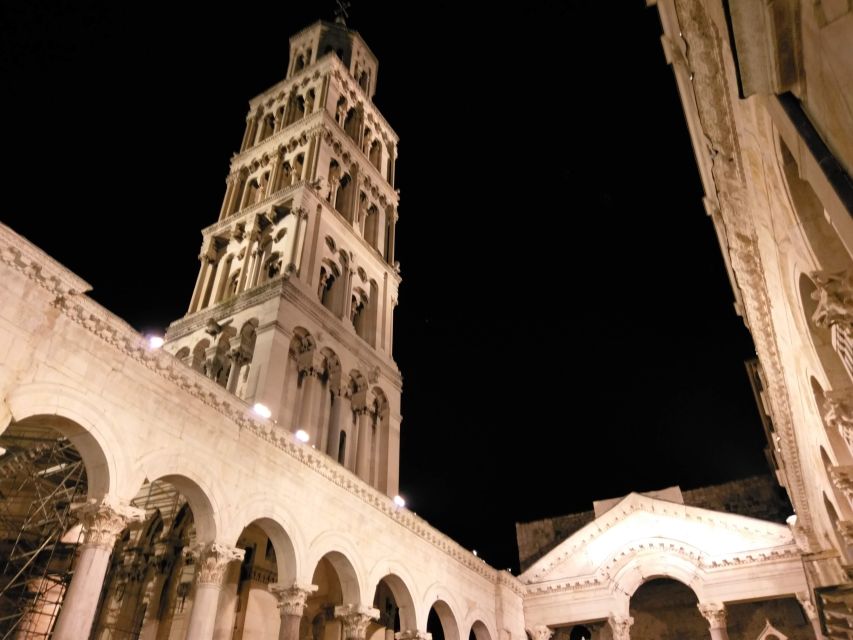
- Roman Split in a compact evening walk: See Diocletian’s cellars, Peristyle, the Jupiter Temple, and the Golden Gate.
- A genuinely private format: The $129 price covers your group, up to 20 people, rather than charging each person separately.
- A flexible pace: Your guide can adjust the walk to your interests and avoid steps if needed.
- A strong guide experience: Zrinka has been praised for her friendly manner, clear explanations, relaxed pace, and restaurant suggestions.
- Mostly an exterior evening tour: Expect the cathedral to be closed, with paid entry to the palace and cathedral excluded.
- An easy finish on the Riva: The route ends beside restaurants and cafés along Split’s waterfront.
Why Split works so well after sunset
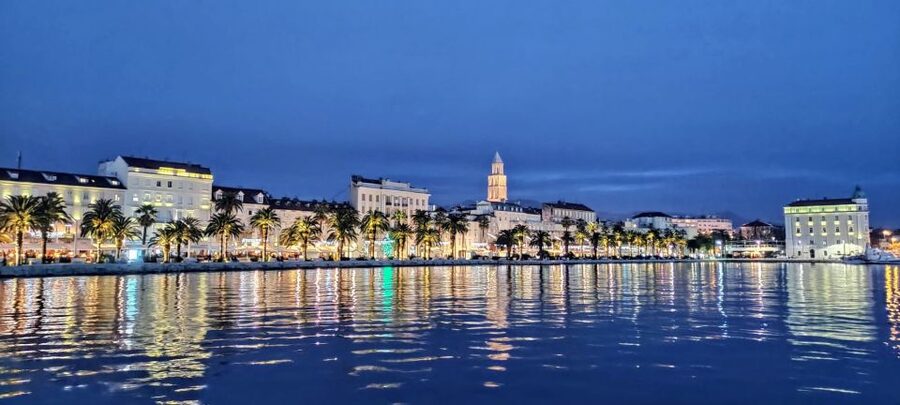
Split is not a museum district sealed off from daily life. The center is a living part of town, with shops, markets, cafés, homes, and people moving through streets first laid out for the Roman emperor Diocletian.
That makes an evening walk a sensible choice. Summer afternoons in Dalmatia can be hot, while the city takes on a more comfortable rhythm later in the day. Squares fill up, the shopping streets become social spaces, and the waterfront offers an easy place to continue your night.
I also like the way this route places several eras next to each other. You begin with the Roman emperor’s palace, pass a cathedral built inside his mausoleum, and then step into medieval and Venetian parts of Split. You do not need a long transfer or a bus ride to see the change. The old town itself supplies the timeline.
The private setup matters most if your group has mixed interests. You can ask for more detail at the Roman remains, keep moving if younger children lose patience, or slow down for photographs. A public group tour has to follow one pace. Here, your guide can shape the two hours around you.
A few more Split half-days worth comparing
- Split: Illuminated Evening Guided Kayaking Tour
★ 4.8 · 1,622 reviews - Split: Stand Up Paddleboard Night Glow Tour
★ 4.9 · 916 reviews - Split: Transparent SUP night Glow tour
★ 4.9 · 73 reviews
Meeting at the Riva and entering Diocletian’s Palace
The stated meeting point is in front of the entrance to the cellars of Diocletian’s Palace at Obala Hrvatskog narodnog preporoda 23 in Split. The starting information also lists Obala Hrvatskog narodnog preporoda 15b, so I would check the exact meeting instructions before setting out. The area is along the Riva, Split’s handsome waterfront promenade.
Your guide leads you from the water into the old town. That opening is useful because it gives you a clear contrast: the open harbor side of modern Split, followed by dense Roman stonework just a short walk away.
The cellars are one of the tour’s key stops. They are unusually well preserved and help you understand the scale and layout of the palace above. Rather than seeing a few isolated columns, you get the sense of a large imperial complex with working spaces below its main ceremonial rooms.
The palace was built for Diocletian, the Roman emperor who chose this part of the Adriatic for his retirement residence. The old walls no longer function as a single palace in the modern sense. Streets, apartments, shops, and religious buildings have grown into the structure, which is exactly what makes the center so interesting.
The tour includes a guided visit to the palace area, but entrance fees to the palace and cathedral are not included. Since the tour takes place in the evening, you should ask ahead about which interior spaces are open at your chosen time. The supplied details specifically warn that the cathedral will likely be closed.
Peristyle, the Jupiter Temple, and the Roman core
From the cellars, you climb toward Peristyle, the palace’s grand central court. This is where the Roman plan becomes easier to read. The space gives your guide a natural place to explain the emperor’s residence, ceremonies, and the way later generations reused the old structure.
You will also see the Jupiter Temple. Its presence adds another layer to the palace story, since the complex was designed not only as a home but also as an imperial and religious center.
The stairs can be avoided if necessary, which is useful for anyone with limited mobility or a group that prefers a flatter route. Still, this is an old stone district, so comfortable shoes are a must. The walking is not a long-distance hike, but uneven surfaces and steps are part of the setting.
A private guide is especially useful here because Roman remains can look abstract without explanation. A column, doorway, or low wall may not say much by itself. With context, you can see how the palace shaped the streets around it and why Split’s center feels different from a standard archaeological park.
St. Domnius Cathedral and the former imperial mausoleum
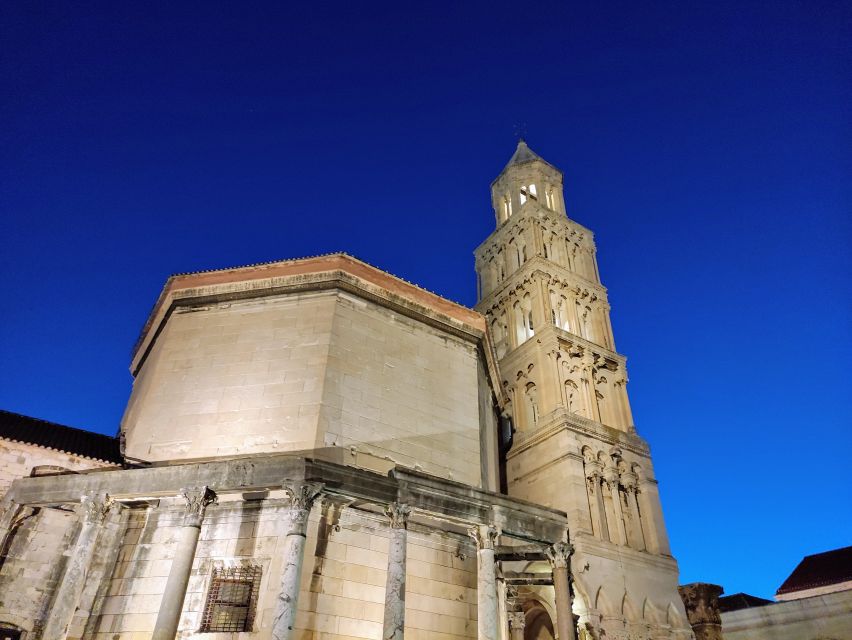
The Cathedral of St. Domnius, also called St. Duje, is dedicated to Split’s patron saint. One of the most striking facts about it is that the building began as Diocletian’s mausoleum. A Roman emperor’s burial structure later became a Christian cathedral, a sharp example of how Split reused its past instead of clearing it away.
The bell tower is another major sight. You can admire it from outside during the walk, and your guide can explain the place it holds in the city’s skyline and religious life.
There is a practical limit here. The tour information says the cathedral will likely be closed because of its operating hours. The itinerary allows a photo stop rather than promising an interior visit. Do not book this walk expecting a guaranteed look inside the cathedral, and remember that any entrance fee is separate.
That limitation does not ruin the stop, but it changes the experience. You are mainly seeing the exterior, the Roman form beneath the church, and the connection between the cathedral and the palace. If entering the cathedral is a top priority, you should arrange a daytime visit separately.
Same stretch of coast, a completely different kind of day:
- Blue Lagoon & 3 Islands Cruise with Lunch from Split
★ 4.5 · 5,756 reviews - Split: Old Town and Diocletian Palace Walking Tour
★ 4.9 · 4,727 reviews - Split: Blue Lagoon Boat Party with DJs, Shots & After Party
★ 4.9 · 4,610 reviews - Split: Blue Lagoon and 3 Islands Speedboat Tour
★ 4.8 · 3,406 reviews
The Golden Gate and Split’s medieval streets
The Golden Gate marks another important point in the palace walls. It was one of the main entrances to Diocletian’s complex, and it gives you a strong sense of the defensive edge of the Roman city.
The gate also helps explain the route itself. Split’s old center is not a collection of unrelated sights. The streets follow the Roman palace plan, then bend into later additions and public spaces. Your guide can point out how the city changed while remaining anchored to the old walls.
After leaving the palace zone, the walk moves into the medieval part of Split. This shift is one of the route’s best features. You are no longer looking only at imperial architecture. You are seeing how ordinary urban life developed around it.
The evening timing should suit photographers who like softer light and lively public spaces. It also means that crowds, shop hours, and access to interiors can vary. The route is strongest as a guided walk through the city’s streets and exteriors, not as an all-access museum visit.
People’s Square and Fruit Square
People’s Square, known as Piazza during the period of Venetian rule, shows another side of Split. The square connects the Roman center with the later civic city. It is a natural place to stop, listen, and take photographs without feeling rushed through a list of monuments.
The Venetian connection is useful context. Split did not develop in one straight line from Roman times to the present. Different rulers and communities left their mark, and the squares give you a way to see those changes in the layout of everyday life.
Fruit Square offers another short visit and photo stop. Its inclusion keeps the tour from becoming too focused on the palace alone. You get streets, public squares, shopping areas, and the social side of the old town.
I would not expect every stop to receive the same amount of time. The palace is the main focus, with about an hour allocated to the guided visit, while the other locations work as shorter stops. That balance makes sense for a two-hour tour, but it means you will get an overview rather than a detailed study of every building.
Finishing along the Riva waterfront
The walk returns to Obala Hrvatskog narodnog preporoda 15b, along the Riva. This is a practical ending because you are close to restaurants and cafés rather than being left in an unfamiliar side street.
The waterfront also gives the tour a pleasant final note. You begin near the harbor, move through the Roman and medieval center, and finish beside the sea again. If you want to keep the evening going, the Riva is the obvious place to sit down for a drink or meal.
One useful touch is the guide’s local dining advice. Zrinka was specifically praised for offering restaurant recommendations, so you can ask for suggestions before the tour ends. That kind of help is often more useful than another minute of dates and names, especially on a short visit to Split.
What the $129 private price really means
The price is $129 per group of up to 20 people. That makes the value depend heavily on your party size. For two people, it is a fairly expensive two-hour walk. For a family or larger group, the per-person cost drops quickly and can compare well with several individual tickets for a small-group experience.
You are paying for a licensed guide and a private format. The main benefit is control: your group can ask questions, request a comfortable pace, and give more or less attention to the palace, cathedral, squares, or food suggestions.
The price does not include entrance fees to Diocletian’s Palace or the Cathedral of St. Domnius. Since the cathedral will probably be closed during the tour, you may not pay that particular fee on the evening walk, but you should budget separately if you plan a daytime interior visit.
I see this as a good value for families, couples traveling with friends, and groups that want one guide without joining strangers. It is less compelling for a solo visitor or a pair who only wants a basic orientation and is happy to explore independently.
Pace, language, and accessibility
The tour lasts two hours and is offered in English, French, or Croatian. A live guide is included, not an audio guide or a self-guided route.
The private format allows the pace to suit your group. One visitor specifically praised Zrinka for keeping a comfortable pace through the palace and surrounding streets. That detail matters because the old town can tempt a guide to rush from one landmark to the next.
Steps can be avoided if necessary, according to the activity details, and the tour is listed as wheelchair accessible. You should still wear comfortable shoes. Split’s historic center includes old stone surfaces, and even an accessible route may feel different from a smooth modern pavement.
The route is suitable for people who want a broad introduction without spending half a day on one site. It also works for a first evening in town, when you want to understand the layout before returning to explore on your own.
Who should book this evening walk?
I would choose this tour if you want a private introduction to Split and care about the story connecting the sights. It is particularly useful if you are traveling with a family or group and do not want to match the pace of strangers.
It also suits you if you prefer an evening outing after a hot day, want restaurant advice, or would like a guide to adjust the emphasis around your interests. The route covers the core old town without requiring transport between stops.
I would look elsewhere if your main goal is entering the cathedral or seeing every paid interior. The late timing makes the walk atmospheric and comfortable, but it limits access. You should also consider the price carefully if only one or two people are booking.
Should you book the Magical Evening Sightseeing Private Tour?
Book it if the private format matters to you and you want a clear, story-led introduction to Split’s Roman, medieval, and Venetian layers. The route is well chosen, the finish on the Riva is convenient, and the option to shape the pace adds real value.
Go in with the right expectations. This is mainly an evening walk through the old town and palace exteriors, not a full interior tour. If you accept that tradeoff, the two hours should leave you with a useful map of Split, a better understanding of Diocletian’s unusual palace, and a good place to continue your night.
FAQ
How long does the Split evening tour last?
The tour lasts two hours.
How much does the private tour cost?
The price is $129 per group of up to 20 people.
Where does the tour meet?
The stated meeting point is in front of the entrance to the cellars of Diocletian’s Palace at Obala Hrvatskog narodnog preporoda 23, 21000 Split. The starting information also lists Obala Hrvatskog narodnog preporoda 15b, so confirm the exact directions before arriving.
Which languages are available?
The live guide is available in English, French, and Croatian.
Is the tour private?
Yes. It is offered as a private group tour, with the price covering up to 20 people.
Are entrance fees included?
No. Entrance fees to the Cathedral of St. Domnius and Diocletian’s Palace are not included.
Will the cathedral be open during the tour?
The cathedral will likely be closed because of its operating hours. The tour includes a photo stop there, but an interior visit is not guaranteed.
Can the tour avoid stairs?
Yes. Steps can be avoided if necessary.
What should I bring?
Bring comfortable shoes for walking through the old town and its stone streets.
Just added around Split
- Split Day Trip from Dubrovnik★ 4.0 · 59 reviews
- Dubrovnik to Split Private Transfer with Local Experienced Driver★ 5.0 · 52 reviews
- Private Transfer from Dubrovnik to Split★ 5.0 · 3 reviews
- Private Transfer from Dubrovnik to Split with 2 hours for sightseeing★ 5.0 · 50 reviews
- Private Transfer: Dubrovnik to Split★ 5.0 · 7 reviews
- Dubrovnik to Split Private Transfer with Mostar Town★ 5.0 · 38 reviews
- Private Tour: Split Day Trip from Dubrovnik★ 5.0 · 9 reviews
- Private Day Trip :Dubrovnik- Mostar- Split★ 5.0 · 3 reviews
Evening Experiences, compared.
Split: Illuminated Evening Guided Kayaking Tour
Read our review →
Pula: Night-Time Sea Kayaking Tour in Transparent Kayak
Read our review →
Transparent Kayak Night Glow Experience from Pula
Read our review →
Pula: Cave Sunset/Night Tour in Transparent Kayak
Read our review →Browse the lists this tour appears in